
Why Helpful Content Is the Secret to Loyal Customers

What Is Helpful Content Marketing and Why Does It Matter?
Helpful content marketing is the practice of publishing information that solves a real problem for your audience before asking for a sale. It matters because most buyers now research on their own, long before they contact a business.

Think about the last time you bought something for your business. You probably searched for answers first. You read a few articles, maybe watched a short video, and formed an opinion about which company seemed to know what it was talking about. That is customer education happening in real time, and it is happening whether or not your business is part of the conversation.
A solid content marketing strategy built on helpful content does three things at once:
- It answers the questions your ideal customer is already typing into a search bar.
- It positions your business as the one that explains things clearly, instead of the one that just wants a sale.
- It gives you something to share on email, social media, and in sales conversations, so you are not starting from zero every time.
Choose this approach if you sell a service or product that requires some explanation before purchase. Skip heavy content investment only if your product is a true commodity with zero decision-making involved, which is rare in B2B services.
How Does Educational Content Build Customer Trust?
Educational content builds trust because it proves your expertise before you ask for anything in return. This is the core idea behind trust marketing: give value first, and credibility follows naturally.
Here is the simple logic behind it. If a business answers your hardest question clearly, for free, you assume they can also handle the paid work well. If a business hides useful information behind a “contact us” form, you assume they have something to protect, or worse, nothing to offer.
Trust builds in layers:
- Recognition: the customer finds your content while researching a problem.
- Relevance: the content actually answers their specific question, not a generic version of it.
- Confidence: they start to believe your business understands their situation.
- Readiness: by the time they reach out, they already trust you enough to have a real conversation instead of a guarded one.
A short story makes this concrete. A Metro Atlanta electrical contractor we worked with used to get calls from people who wanted three competing quotes before deciding anything. After they started publishing simple explainer content about how commercial electrical upgrades are priced, the calls changed. People arrived already convinced the company knew its business. They asked fewer price-shopping questions and more “when can you start” questions. That shift is trust marketing working exactly as it should.
What’s the Difference Between Helpful Content and Promotional Content?
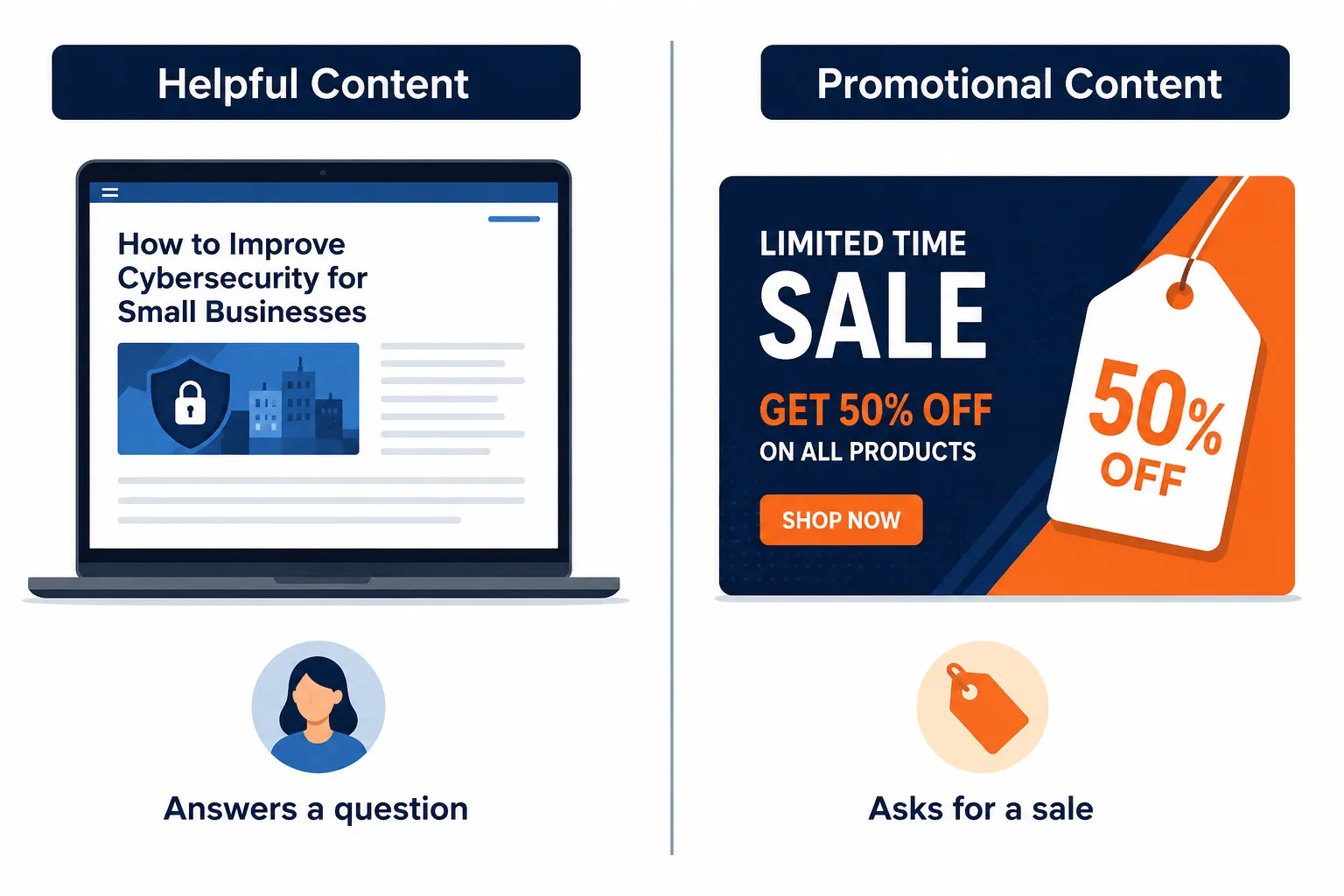
Helpful content teaches something useful without asking for a sale; promotional content asks for a sale first and explains second. Both have a place, but confusing the two is one of the fastest ways to lose a reader’s trust.
| Factor | Helpful Content | Promotional Content |
|---|---|---|
| Main goal | Answer a question or solve a problem | Generate a sale or lead directly |
| Reader’s guard | Lowered, because there’s no immediate ask | Raised, because the pitch is obvious |
| Best used | Early research stage | Decision stage, after trust exists |
| Example | “How to price a commercial electrical upgrade” | “20% off your first electrical inspection” |
| Trust impact | Builds credibility over time | Can erode credibility if used too early |
| SEO value | Strong, matches search intent | Weak, rarely matches informational searches |
Decision rule: if your content answers a question a stranger would type into Google, it’s helpful content. If it only makes sense to someone who already wants to buy from you, it’s promotional content. A healthy content marketing strategy uses both, but leads with the helpful kind.
What Are the Best Practices for Creating Educational Content That Converts?
The best educational content answers one clear question per piece, uses plain language, and ends with a natural next step instead of a hard sell. Content that tries to do too much at once usually helps no one.
A few practices that consistently work for small business owners:
- Start with real questions. Pull them from customer emails, sales call notes, and support tickets. These are proven questions, not guesses.
- Answer first, explain second. Give the direct answer in the first sentence or two, then add detail for readers who want more.
- Use plain words. Avoid industry jargon your customer wouldn’t use themselves.
- Add one clear next step. A helpful checklist, a related article, or a low-pressure invitation to talk, not a hard pitch.
- Publish on a schedule you can actually keep. One useful article every two weeks beats ten rushed ones that stop after a month.
Common mistake: writing content that’s technically accurate but skips the part your customer actually cares about, like cost, timeline, or what happens if something goes wrong. Always answer the practical question, not just the technical one.
How Much Does It Cost to Produce Helpful Content at Scale?
Costs range widely depending on whether you write it yourself, hire freelancers, use an agency, or work with a done-for-you system. There is no single “correct” number, but the ongoing cost of doing it wrong, through wasted time or inconsistent publishing, is usually higher than any of these options.
Rough categories small businesses fall into:
- DIY writing: low cash cost, high time cost. Owners often burn out and stop after a few months.
- Freelance writers: moderate cost per piece, but usually no strategy behind the topics chosen.
- Marketing agencies: higher monthly cost, often with long contracts and slow turnaround.
- All-in-one platform with content built in: a predictable monthly cost that also includes the website, lead capture, and follow-up, so you’re not paying separately for five different tools.
Edge case: if you already have a full-time marketer on staff who understands SEO and sales, you may not need outside help. Most companies under $20 million in revenue with lean teams do not have that person, which is exactly the gap a done-for-you system is built to fill.
What Tools Do You Need to Create Educational Content?
At minimum, you need a website to publish on, a way to capture visitor information, and a system to follow up automatically. Trying to stitch these together from separate tools is where most small businesses get stuck.
A workable content setup includes:
- A website that’s fast, mobile-friendly, and easy to update without a developer
- A simple content calendar so topics don’t get chosen at random
- AI-powered lead capture on every page, so interested readers become tracked contacts instead of anonymous traffic
- Automated follow-up systems that nurture a reader after they leave your site
- Basic analytics to see which content actually attracts the right kind of visitor
This is precisely why we built SalesHubHQ as a complete done-for-you system. We build the website and content for you, so you’re not managing five subscriptions and a freelancer at the same time. You get a free smart website built for you, ready from day one, with no tech knowledge required on your end.
How Do You Measure If Your Helpful Content Is Actually Working?
You know helpful content is working when it brings in the right kind of leads, not just more traffic, and when those leads arrive already informed and easier to close. Traffic alone tells you very little.

Track these signals instead:
- Qualified leads captured from content pages, not just total visits
- Time from first visit to first conversation, which should shrink as trust builds
- Questions sales hears on calls; fewer basic questions usually means your content is doing its job upfront
- Repeat visits to your site from the same contact before they convert
- Which specific articles show up most often in a lead’s activity history before they book a call
Decision rule: if a piece of content gets traffic but never appears in your lead’s journey before conversion, it’s probably not helpful in the way that matters. Revisit the topic or the call to action.
Why Do Customers Leave When Content Isn’t Helpful Enough?
Customers leave content that doesn’t answer their question fast enough, because they assume the business either doesn’t understand their problem or is hiding something. Attention online is short, and confusion is expensive.
Common reasons visitors bounce:
- The headline promises an answer the content never actually delivers
- The page buries the useful part under paragraphs of unrelated background
- The content reads like a sales pitch dressed up as an article
- There’s no clear next step, so even an interested reader has nowhere to go
Once a visitor leaves disappointed, they rarely come back to give you a second chance. They go find the competitor whose content actually answered the question. This is why a content marketing strategy focused on customer education isn’t optional polish. It’s the difference between earning a lead and losing one silently, with no record of why it happened.
What Are the Common Mistakes Brands Make With Educational Content?
The most common mistake is publishing content that talks about the business instead of the customer’s problem. A close second is publishing inconsistently, then giving up before the content has time to build any trust.
Other mistakes we see often with small business clients:
- Writing for peers, not customers. Using internal jargon that confuses the actual buyer.
- Skipping the follow-up. Publishing great content but having no automated follow-up systems to nurture the reader afterward.
- No clear ownership. Content becomes “something we’ll get to,” so it never happens consistently.
- Chasing trends instead of questions. Writing about what’s popular instead of what your specific customer actually needs answered.
- Measuring the wrong thing. Celebrating pageviews while ignoring whether any of those visitors became leads.
Common mistake, worth repeating: treating content as a one-time project instead of an ongoing system. A predictable growth system needs content that keeps working in the background, not a single burst of articles that goes stale after a quarter.
Who Benefits Most From Helpful Content Marketing, and Who Shouldn’t Rely on It Alone?
Helpful content marketing benefits businesses with a real sales cycle, where the buyer needs to understand something before deciding, which describes most B2B service and professional firms. It benefits less, on its own, businesses that sell purely on price or impulse with almost no research phase.
Benefits most:
- Professional services (legal, accounting, consulting, agencies)
- B2B companies with technical or custom offerings
- Businesses competing against larger, better-funded competitors on expertise instead of ad spend
- Companies with a longer sales cycle where trust needs to build over multiple touchpoints
Shouldn’t rely on educational content alone:
- Businesses selling true commodities with no decision complexity (a single fixed-price item with no variation)
- Companies needing an immediate spike in sales this week, since content builds trust gradually, not overnight
- Businesses with no consistent way to capture and follow up with the leads content generates, since the content becomes wasted effort without a system behind it
How Long Does It Take to See Results From a Helpful Content Strategy?
Most small businesses start noticing early signals, like more qualified inquiries or better sales conversations, within a few months of consistent publishing, with stronger results building over six to twelve months. Content marketing is a compounding effort, not a switch you flip.
What affects the timeline:
- Publishing consistency: sporadic content takes much longer to gain traction than a steady schedule
- Existing website authority; newer websites take longer to earn visibility for their content
- Competition in your local market; less competitive niches often see faster movement
- Whether lead capture and follow-up are in place, content without a way to capture interest wastes the traffic it earns
Edge case: if you already have an engaged email list or a strong local reputation, useful content can start producing conversations within weeks because you’re feeding an audience that already trusts you somewhat. Starting from zero visibility naturally takes longer.
Can Helpful Content Work for B2B and B2C, or Just One?
Helpful content marketing works for both B2B and B2C, but the format, tone, and buying trigger differ. B2B buyers research more before contacting anyone, so educational content plays a bigger role earlier in their journey.
- B2B (our core audience at SalesHubHQ): buyers often compare multiple options, involve more than one decision-maker, and need proof of expertise before a first call. Content that explains process, pricing logic, and what to expect tends to perform best.
- B2C: buyers move faster and respond more to content that removes a specific worry or answers a quick practical question, like “how long does this take” or “is this safe.”
Choose a B2B-heavy content approach if your sales cycle involves proposals, multiple stakeholders, or a service that’s customized per client, which describes most of the Metro Atlanta B2B service firms we work with.
How Do You Turn Helpful Content Into Paying Customers?
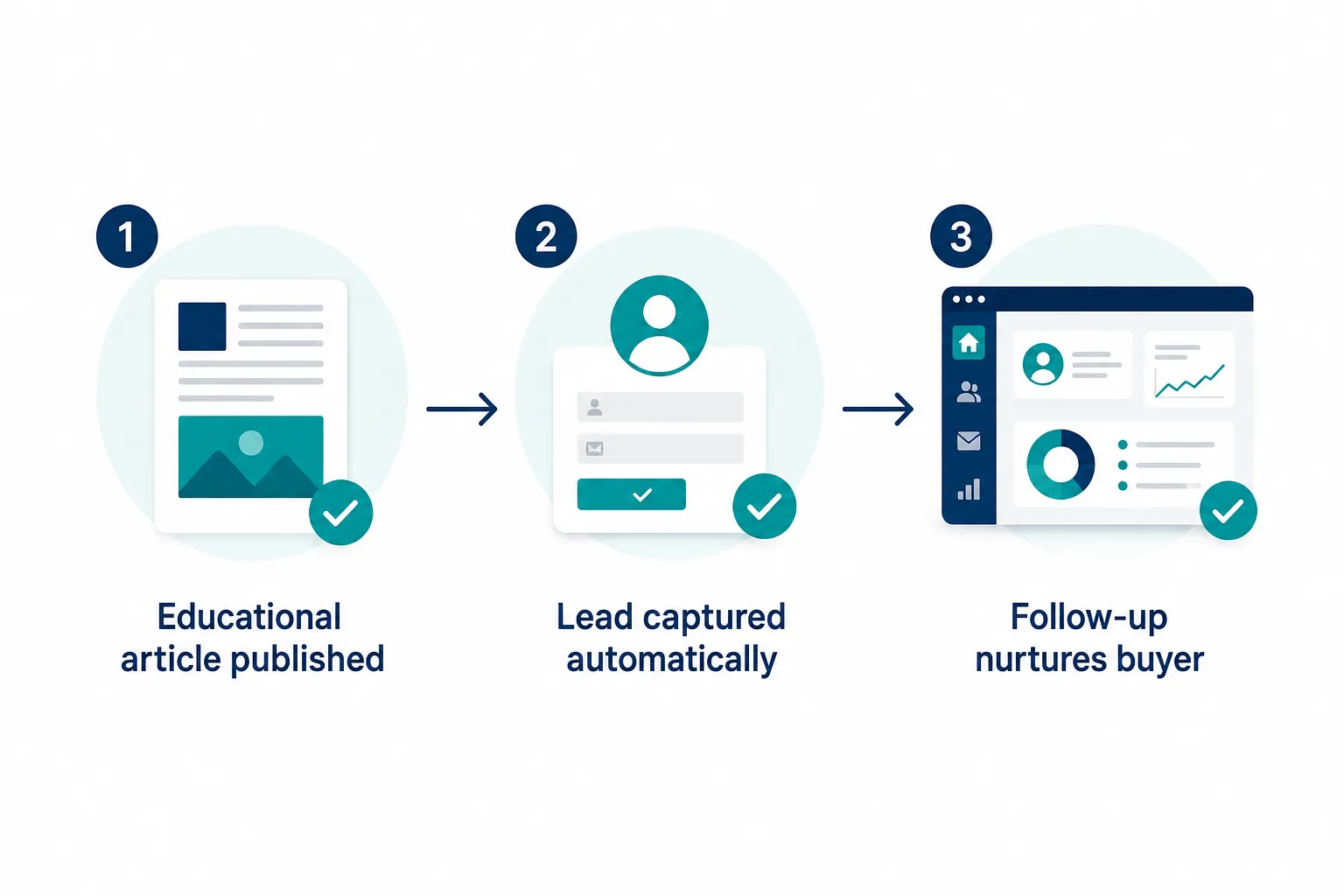
Helpful content turns into paying customers when it’s paired with a system that captures the reader’s information and follows up automatically, so no interested visitor slips away unnoticed. Content without capture is just free advice with no return.
Here’s the sequence that actually works:
- Publish content that answers a real question your ideal customer is asking right now.
- Capture the reader’s interest the moment they engage, through AI-powered lead capture built into the page itself.
- Nurture automatically so leads captured and nurtured automatically move toward a conversation without you manually chasing every name on a list.
- Hand off warm leads to sales, already informed and further along than a cold contact would ever be.
This is the exact gap we close at SalesHubHQ. We don’t just hand you a content calendar and wish you luck. We build and implement the entire system for your business: the free smart website built for you, the educational content that supports it, the AI-powered lead capture on every page, and the automated follow-up systems that keep nurturing a lead after they leave your site. It’s a complete done-for-you system, an all-in-one platform built as your predictable growth system, ready from day one, with no tech knowledge required on your side. You focus on running your business. We focus on making sure your systems actually work.
Helpful Content Readiness Check
Use the interactive tool below to see how ready your current content is to build trust and generate leads.

