
How to Build a Powerful Small Business Growth System

What Is a Small Business Growth System and How Does It Work?
A small business growth system is a connected process that turns strangers into leads, leads into customers, and customers into repeat business, automatically, on a schedule you can count on. It works by linking six parts so that each one feeds the next, instead of running marketing and sales as separate, disconnected efforts.
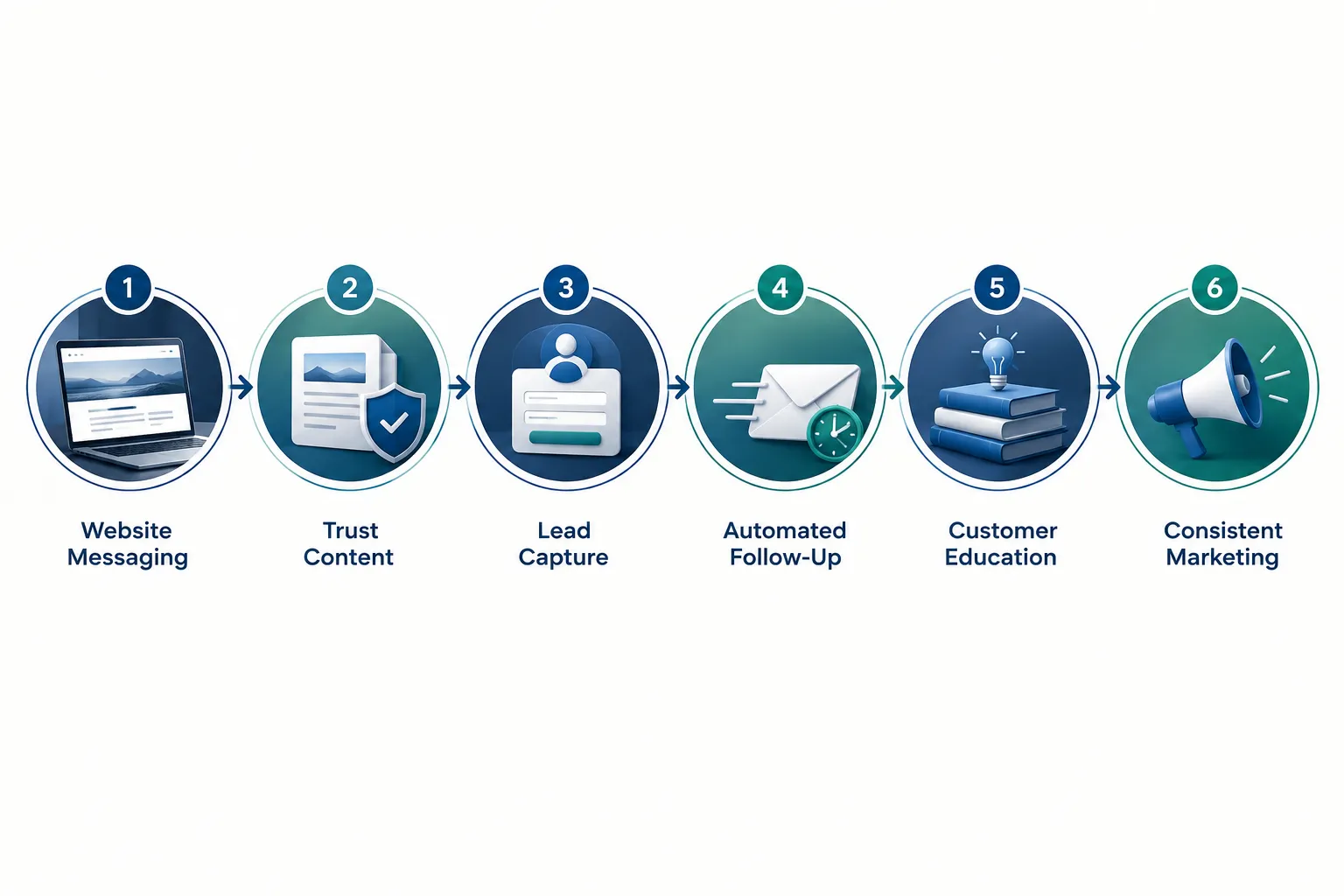
Here’s how the six parts connect:
- Website messaging: Your site tells visitors exactly what you do, who you help, and why you’re different, in seconds, not paragraphs.
- Trust-building content: Case studies, reviews, and clear proof show visitors you can deliver before they ever talk to you.
- Lead capture: Forms, chat tools, and offers turn anonymous visitors into named contacts you can follow up with.
- Automated follow-up: Emails and texts go out on their own, so no lead sits ignored for days.
- Customer education: Ongoing content answers objections and questions before a salesperson has to.
- Consistent marketing: Regular visibility (email, social, ads) keeps your business top of mind until a prospect is ready to buy.
Decision rule: If any one of these six parts is missing, your business doesn’t have a system yet; it has a set of tactics. A marketing system only produces predictable business growth once all six are connected and running without you having to remember to do them manually.
How Long Does It Take to See Results From a Growth System?
Most businesses see early signals- more website inquiries, faster lead responses, better-quality conversations- within 30 to 60 days of launching a growth system. Compounding results, where leads arrive on a steady rhythm without constant manual effort, typically show up between month three and month six.
This timeline depends on a few factors:
- Starting point: A business with no website or lead capture in place will see a bigger initial jump than one tweaking an existing setup.
- Sales cycle length: A quick-decision service (like a repair company) sees faster results than a longer B2B sales cycle (like commercial insurance or IT consulting).
- Follow-up speed: Systems with automated follow-up convert leads faster than businesses relying on manual callbacks.
Common mistake: expecting a lead generation system to behave like a light switch. It behaves more like a flywheel, slow to start, then steadily easier to keep moving once trust, content, follow-up sequences, and consistent marketing are all running together.
What’s the Difference Between Growth Systems and Traditional Marketing?
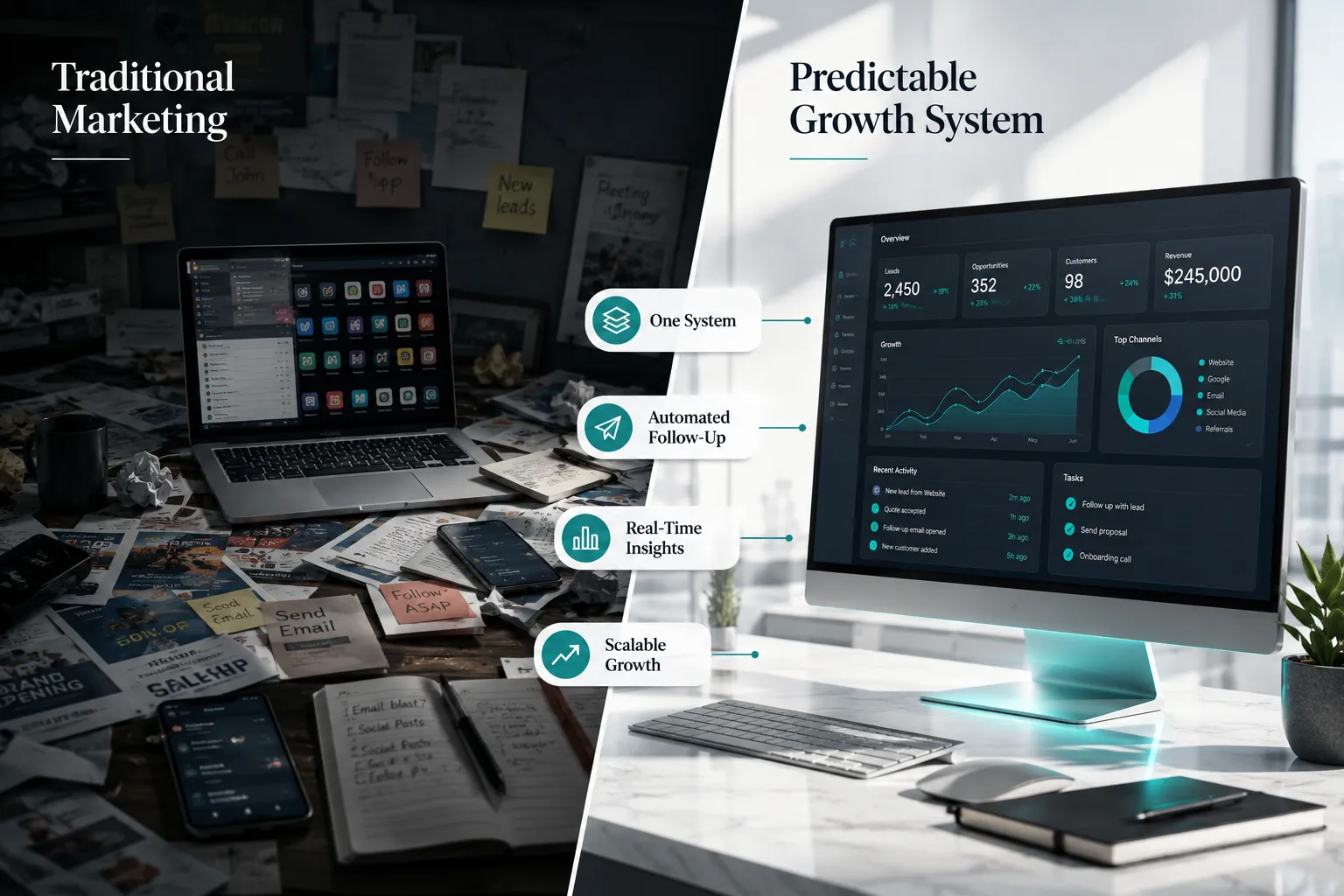
Traditional marketing is a series of separate campaigns: a Facebook ad here, a mailer there, a referral push next quarter. A predictable growth system is a permanent, connected process that runs continuously, so results don’t disappear the moment a campaign budget runs out.
| Traditional marketing | Small business growth system |
|---|---|
| One-off campaigns with a start and end date | Continuous process that runs year-round |
| Manual follow-up (or none at all) | Automated follow-up systems triggered instantly |
| Results tied to ad spend that week | Results build over time, even between campaigns |
| Tools often disconnected from each other | All-in-one platform connecting every step |
| Owner has to remember to “do marketing” | Runs in the background, ready from day one |
Traditional marketing can still generate a short-term spike in leads. But without a system underneath it, lead capture, follow-up, and nurturing- that spike fades fast and leaves nothing behind. A sustainable business growth approach treats every campaign as fuel for a system that keeps working long after the campaign ends.
Can a Growth System Work for My Specific Industry?
Yes. A growth system works for any B2B service or professional business with a defined target customer and a sales process longer than a single impulse purchase, which describes most companies under $20 million in revenue. The mechanics stay the same; only the content and follow-up cadence change by industry.
Examples of how the same system adapts:
- Professional services (law, accounting, consulting): Trust content leans on credentials, case results, and educational guides.
- B2B services (IT, staffing, commercial contractors): Lead capture often centers on quote requests, and follow-up focuses on speed-to-response.
- Home and field services: Follow-up sequences are shorter and more urgent since customers often want a fast answer.
Edge case: highly regulated industries (like certain financial or healthcare services) need extra care with compliance language in follow-up messaging, but the underlying growth system structure- capture, nurture, educate, close- still applies.
How Much Does It Cost to Implement a Predictable Growth System?
Cost depends on whether you build the system piece by piece with separate tools and staff, or use a done-for-you system that bundles everything into one platform. Piecing it together yourself usually costs more over time because you’re paying for multiple subscriptions plus the hours it takes to connect them.
Here’s what typically drives cost up or down:
- DIY with separate tools: website builder, CRM, email platform, and ad tools each carry their own subscription, and none of them talk to each other automatically.
- Hiring in-house marketing staff: salary, benefits, and training add up fast for a business under $20 million in revenue, and one person rarely covers strategy, content, and tech setup alone.
- Hiring an agency: often billed monthly with limited transparency into what’s actually built for you versus recycled from other clients.
- A complete done-for-you system: one predictable cost that includes the platform, the website, and the setup, no separate line items to manage.
Choose the done-for-you route if: you have no dedicated marketing staff, limited time to manage tools, and you want no tech knowledge required to get a system live.
What Happens If My Business Doesn’t Fit the Growth System Model?
Almost every B2B service or professional business fits the growth system model, because the model is really just “attract, capture, nurture, close”, a pattern every sales process follows in some form. The businesses that struggle are usually missing a clear target customer, not missing a fit for the system itself.
Signs you may need to fix something before the system can work:
- You can’t describe your ideal customer in one sentence.
- Your offer changes depending on who’s asking, with no consistent pricing or packaging.
- You have no way to track where a lead came from.
Common mistake: assuming a growth system won’t work because “my industry is different.” In nearly every case, the issue is unclear messaging or an undefined target customer, not the system itself. Fixing the message almost always fixes the fit.
Common Mistakes Businesses Make When Setting Up a Growth System
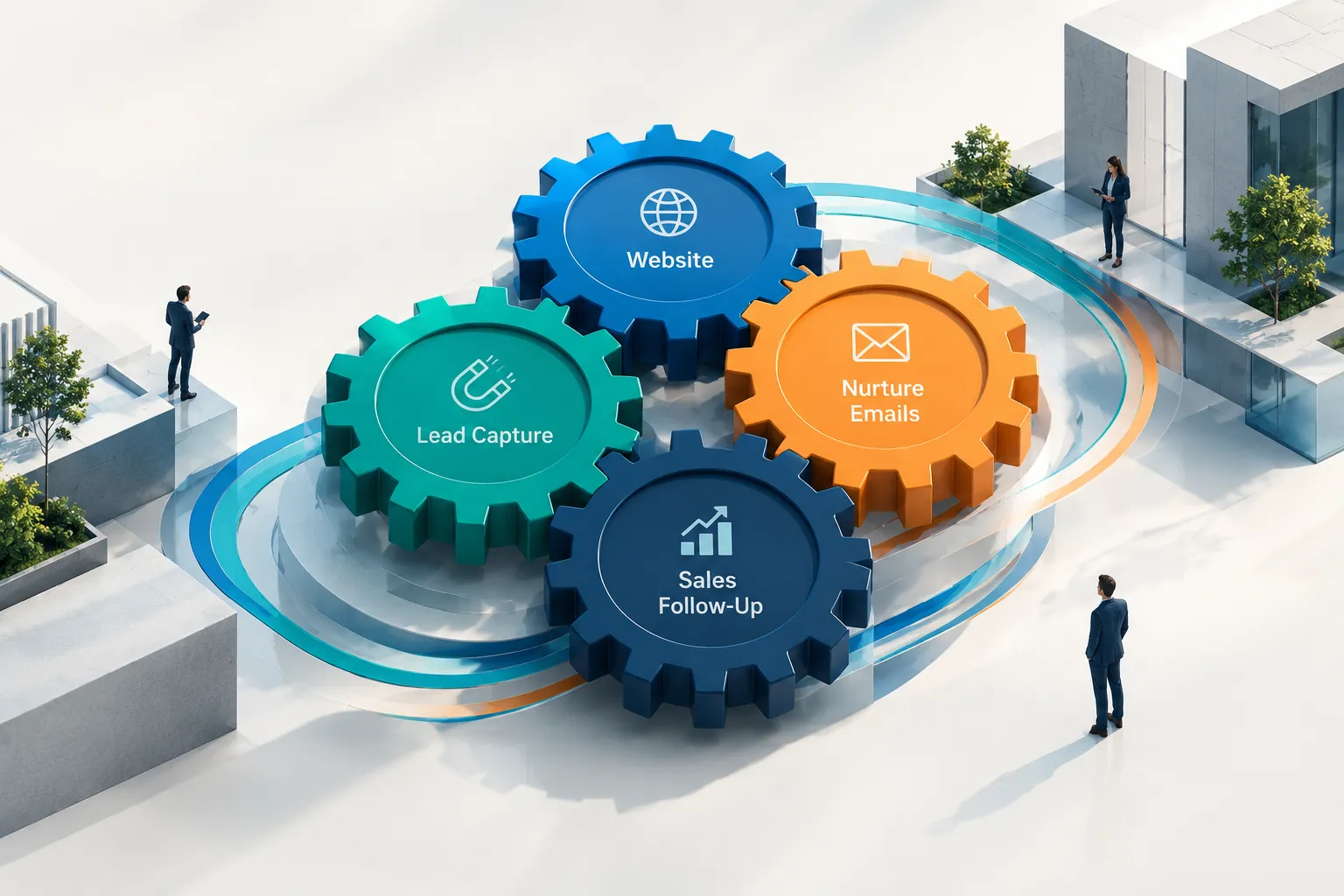
The most common mistake is stitching together five or six disconnected tools instead of using one unified platform, which creates gaps where leads fall through. A growth system only works if every part hands off to the next part automatically.
Other frequent mistakes:
- Skipping automated follow-up. A lead capture system without automated follow-up systems just creates a list of names nobody contacts.
- Weak website messaging. If a visitor can’t tell what you do in the first few seconds, they leave before your trust content ever gets a chance to work.
- No consistent marketing cadence. Running a campaign once and going quiet for three months breaks the compounding effect a marketing system depends on.
- Treating leads as “closed” too early. Many buyers need customer education content over weeks or months before they’re ready to talk.
- No way to measure results. Without tracking, you can’t tell which part of the system is working and which part needs fixing.
Quick example: a Metro Atlanta consulting firm we’ve seen this pattern with had a nice website and ran occasional LinkedIn ads, but had no automated follow-up. Leads came in, sat in an inbox for days, and went cold. Adding automated follow-up alone doubled their response rate, before anything else changed.
How Do I Measure if My Growth System Is Actually Working?
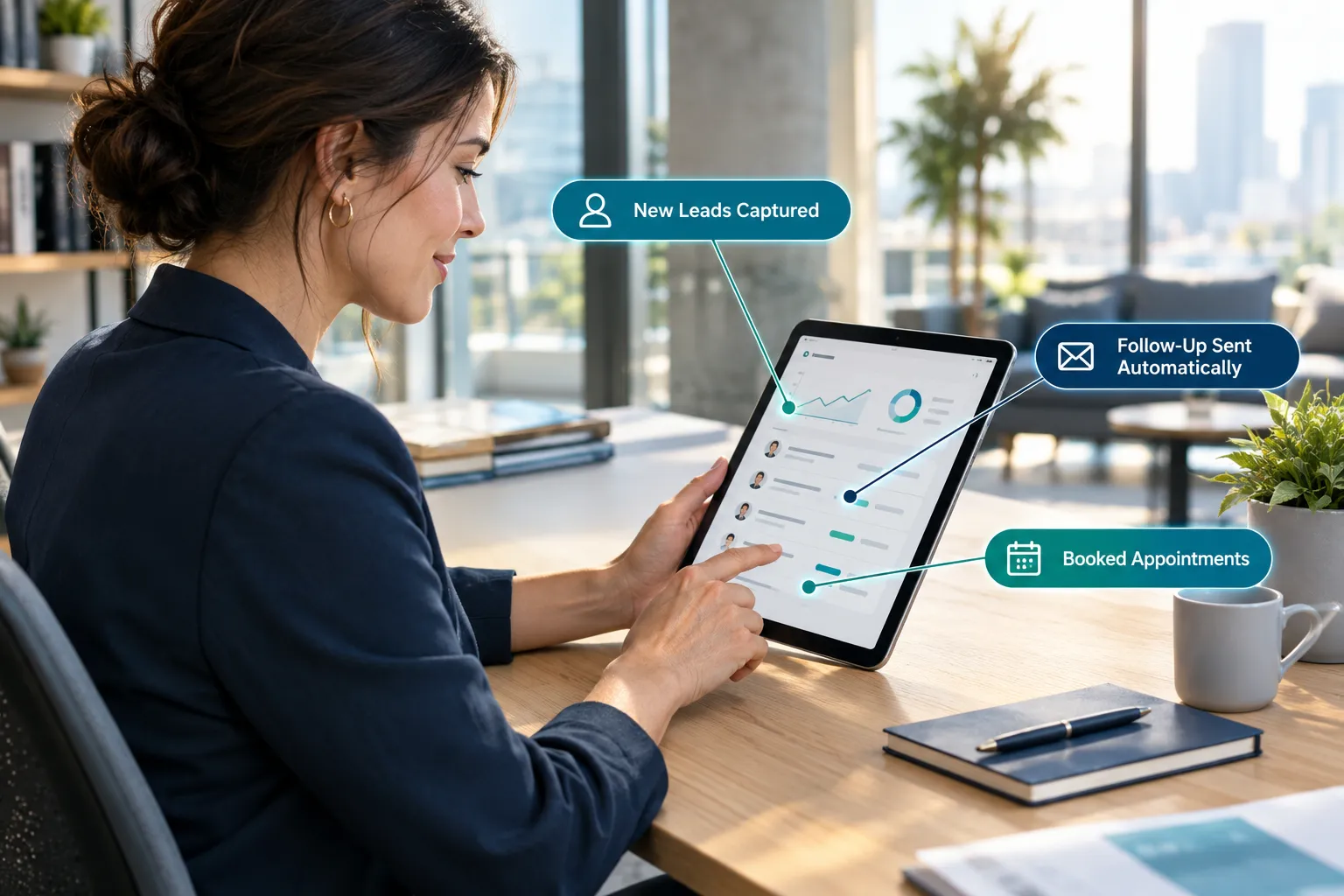
You measure a growth system by tracking leads captured, response time, and conversion rate at each stage, not just total website visits. Traffic without conversion tells you almost nothing about whether the system is actually producing business.
Metrics worth watching monthly:
- Leads captured: how many visitors turn into a name, email, or phone number.
- Response time: how fast a new lead receives a first follow-up (ideally minutes, not days).
- Nurture engagement: how many leads open or respond to follow-up emails and texts.
- Conversion rate: how many leads turn into booked calls, quotes, or closed deals.
- Source tracking: which channel (website, referral, ad) is producing the leads that actually close.
Decision rule: if leads are coming in but conversions aren’t rising, the problem is usually follow-up or trust content, not lead volume. Don’t spend more on ads before fixing what happens after someone raises their hand.
What’s the Best Lead Generation System for Small Businesses?
The best lead generation system for a small B2B or professional service business combines a clear, conversion-focused website with AI-powered lead capture and automated follow-up, all inside one connected platform. Standalone lead magnets or ads without a capture-and-follow-up system behind them waste most of the traffic they generate.
What a strong lead generation system includes:
- A website built to answer “what do you do and why should I care” instantly, not just look nice.
- Multiple capture points: contact forms, chat, booking calendars, and downloadable guides.
- Instant, automated response the moment a lead comes in, no waiting for someone to notice.
- A nurture sequence that keeps educating the lead until they’re ready to buy.
Choose an all-in-one platform if you want leads captured and nurtured automatically without manually checking five different apps every day. That’s the entire point of a unified system; it removes the manual chasing.
Do I Need a Team to Run a Predictable Growth System, or Can I Do It Alone?
You don’t need a marketing department to run a predictable growth system, but you do need either the time to learn several tools or a done-for-you system built and implemented for your business. Most owners of lean B2B companies choose the second option because their time is better spent on sales and delivery.
What running it alone typically requires:
- Comfort learning a CRM, email platform, and website editor.
- A few hours each week to review leads and tweak messaging.
- Patience during the setup phase, which can take weeks without help.
What a done-for-you system removes:
- No tech knowledge required to get the system live.
- We build the website and content for you, so there’s nothing to learn from scratch.
- The system is ready from day one instead of weeks or months into a DIY build.
Edge case: if you already have an in-house marketing hire, a platform still helps by giving that person one system to manage instead of five disconnected tools.
What if My Business Is Seasonal or Has Unpredictable Demand?
A growth system still works for seasonal or unpredictable-demand businesses; it just runs on a different rhythm, with nurture content that keeps leads warm during slow periods so you’re not starting from zero when demand picks up. The system doesn’t need constant demand to be useful; it needs consistent activity.
How seasonal businesses adapt the model:
- Off-season: focus on trust content and customer education to stay visible without a hard sales push.
- Pre-season: ramp up lead capture and follow-up speed as demand approaches.
- Peak season: automated follow-up becomes critical, since manual response time collapses under higher lead volume.
Quick example: a landscaping or HVAC company can use quiet winter months to build a library of trust content and keep past leads engaged, so when spring demand hits, those leads convert faster instead of having to be found and warmed up all over again.
How Does a Sustainable Growth System Differ From Aggressive Scaling?
Sustainable business growth builds capacity and demand together, so leads coming in match what your team can actually deliver. Aggressive scaling pushes lead volume up fast, often outrunning fulfillment, service quality, or cash flow.
Key differences:
- Sustainable growth grows lead flow gradually, matched to hiring and delivery capacity.
- Aggressive scaling spends heavily on ads to spike volume, sometimes before the business can handle it.
- Sustainable growth relies on repeatable systems that keep working with minimal added spend.
- Aggressive scaling often requires continuously increasing spend to maintain the same lead volume.
Decision rule: choose sustainable growth if you’re under $20 million in revenue with a lean team; this is nearly always the safer path, since a lead surge without the staff to handle it damages your reputation faster than slow growth ever would.
What Tools Do I Need to Automate Lead Generation?
At minimum, you need a website that captures leads, a CRM to store and track them, and an automation tool to send follow-up messages, ideally combined in one all-in-one platform rather than three separate subscriptions. Disconnected tools create the exact gaps a growth system is supposed to eliminate.
Core tools a lead generation system needs:
- Conversion-focused website with clear messaging and visible calls to action.
- Lead capture forms and chat placed where visitors are already looking.
- CRM to store every lead and track where they are in the process.
- Automated follow-up systems (email and text) triggered the moment a lead comes in.
- Reporting dashboard to see what’s working without digging through spreadsheets.
Common mistake: buying tools one at a time as problems come up, which is how most businesses end up with five logins that don’t share data. A unified platform avoids that from the start.
Is a Growth System Better Than Hiring a Marketing Agency?
For most small B2B businesses under $20 million in revenue, a done-for-you growth system is more cost-predictable and transparent than a traditional agency, because you’re paying for a complete system rather than hourly strategy work with unclear deliverables. Agencies can still make sense for large, complex campaigns, but many lean businesses end up paying agency fees for work a unified platform already automates.
Where agencies still make sense:
- Large-scale brand campaigns with big media budgets.
- Highly custom creative work outside a standard system’s scope.
Where a done-for-you growth system usually wins:
- Predictable monthly cost instead of open-ended retainers.
- Systems that actually work continuously, not just during an active campaign.
- One point of ownership instead of coordinating between an agency and your internal team.
Decision rule: if you want a free smart website built for you, automated follow-up, and one dashboard to check instead of monthly agency reports to interpret, a complete done-for-you system is the more direct path to predictable growth.
How the SalesHubHQ Growth System Brings This All Together
SalesHubHQ combines every part of this article into one complete done-for-you system: a free smart website built for you, AI-powered lead capture, and automated follow-up systems, all running on a single all-in-one platform. You don’t have to piece together tools or hire a team to make it work.
Here’s what that looks like in practice:
- We build the website and content, so your messaging is clear from day one, not something you have to write yourself.
- AI-powered lead capture on every page, so no visitor slips through without a way to reach you.
- Automated follow-up systems make sure leads are captured and nurtured automatically, even after hours.
- No tech knowledge required; the system is ready from day one and built and implemented for your business, not left for you to configure.
This is what a predictable growth system is supposed to feel like: less manual chasing, more leads showing up already warmed up, and a business owner who can focus on closing deals instead of managing software.
Conclusion: Building Your Predictable Growth System
Sustainable business growth doesn’t come from a lucky referral or a single great campaign; it comes from a connected system that captures, nurtures, and educates leads every single day, whether you’re actively working on marketing that week or not. The six parts covered here- messaging, trust content, lead capture, follow-up, education, and consistent marketing- only produce predictable business growth when they’re built to work together.
If you’re running a lean team and don’t have time to become a marketing technologist on top of running your business, here’s what to do next:
- Audit your website messaging: can a stranger tell what you do in five seconds?
- Check your lead capture: is every page giving visitors a way to reach you?
- Test your follow-up speed: how long does a new lead actually wait for a response?
- Look for gaps between your tools; are leads falling through the cracks between systems?
You don’t have to build this alone. Learn more about the SalesHubHQ Growth System and see how a complete done-for-you system, built and implemented for your business, can get your leads captured, nurtured, and converted automatically, starting now.

