
How to Escape the Marketing Trap Holding You Back


Why Is My Small Business Not Growing Even Though I’m Working Hard
Your small business isn’t growing despite hard work because effort and results aren’t directly correlated without strategic direction. Working harder on the wrong activities or executing good tactics in the wrong order creates the illusion of progress while keeping you stuck in place.
The harsh reality is that most small business owners confuse activity with achievement. You might be posting on social media daily, sending newsletters, networking regularly, and updating your website, but if these activities aren’t aligned with a clear strategy, they become expensive busy work.
Common signs you’re working hard without strategic focus:
- You’re active on multiple marketing channels but can’t identify which ones drive actual customers
- Your calendar is packed with networking events, but few conversations turn into qualified leads
- You’re constantly creating content but struggle to explain how it connects to your business goals
- Your marketing feels reactive rather than proactive, responding to trends instead of following a plan
The solution starts with stepping back from daily tactics to examine your strategic foundation. Most successful businesses that break through growth plateaus discover they needed to fix their positioning, clarify their messaging, or improve their follow-up systems before any marketing tactics could work effectively.
Strategic questions that reveal the real problems:
- Can you clearly explain what makes your business different in one sentence?
- Do you know exactly who your ideal customer is and where they spend their time?
- Can you track a prospect’s journey from first contact to paying customer?
- Do you have systems that nurture leads consistently without your daily involvement?
What Does a Business Growth Plateau Actually Mean
A business growth plateau means your revenue, customer acquisition, or other key metrics have stagnated despite continued marketing and operational efforts. It’s not a temporary fluctuation but a sustained period where traditional growth drivers stop producing results.
Plateaus differ from temporary slowdowns because they persist even when you increase effort or investment. You might double your advertising spend, attend more networking events, or hire additional staff, but the fundamental growth metrics remain flat or decline.
Three types of business plateaus:
Revenue plateau: Your monthly or annual revenue stays within a narrow range despite marketing investments. This often happens when businesses max out their current customer base without expanding their market reach or service offerings.
Customer acquisition plateau: You’re attracting the same number of new customers each month, but can’t break through to the next level. This typically indicates you’ve saturated your current marketing channels or positioning.
Operational plateau: Your business can handle current demand efficiently, but struggles to scale operations for growth. This creates a ceiling where taking on more customers would compromise service quality or overwhelm your systems.
Why plateaus happen after initial success:
Early business growth often comes from low-hanging fruit like personal networks, referrals, and basic marketing tactics. Once you exhaust these easy opportunities, continued growth requires more sophisticated strategies, systems, and positioning.
The transition from startup hustle to sustainable growth demands different skills and approaches. What got you to your current level won’t necessarily take you to the next one, creating the frustrating experience of working harder while seeing diminishing returns.
How Do I Know If My Marketing Strategy Is Actually Failing
Your marketing strategy is failing if you can’t trace a clear path from marketing activities to paying customers, regardless of how busy your marketing calendar looks. Failed marketing creates activity without accountability, making it impossible to identify what works and what doesn’t.
Definitive signs of marketing failure:
- You can’t identify which marketing channels produce your best customers
- Your cost per lead is increasing while lead quality is decreasing
- Marketing activities consume significant time and budget but don’t correlate with revenue growth
- You’re constantly switching tactics because nothing seems to work consistently
The difference between failing tactics and failing strategy:
A failing tactic might be a poorly performing Facebook ad or an unsuccessful networking event. A failing strategy is a fundamental misalignment between your marketing approach and your business goals, target market, or value proposition.
You might have excellent individual tactics that fail because they’re not coordinated or because they’re targeting the wrong audience. Conversely, you might have a solid strategy that’s poorly executed through weak tactics.
How to audit your marketing strategy:
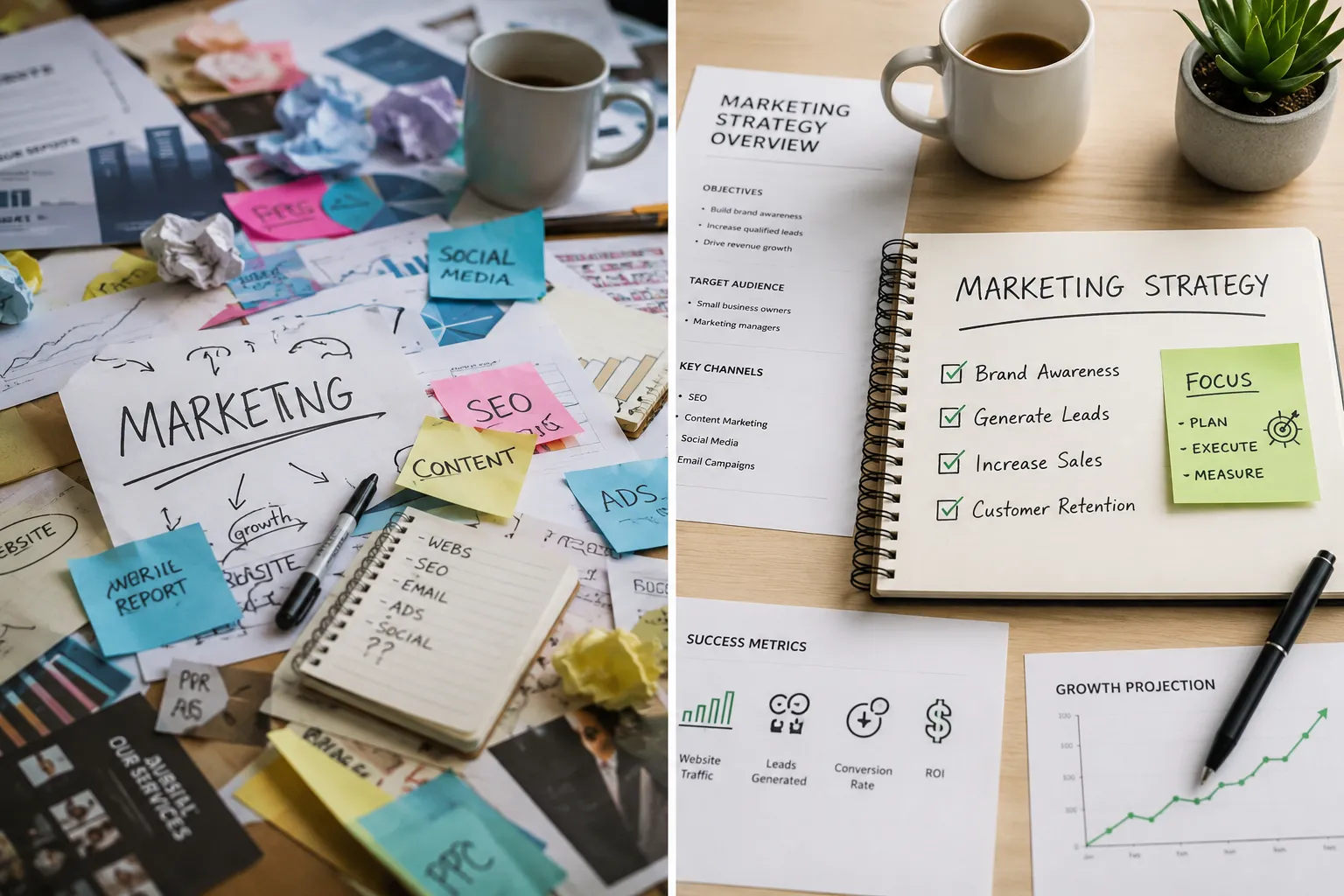
Start by mapping your customer journey from awareness to purchase. If you can’t clearly identify how prospects move through each stage, your strategy lacks the foundation needed for consistent results.
Next, examine whether your marketing messages address real customer problems or just highlight features you think are important. Failed marketing often focuses on what the business wants to say rather than what customers need to hear.
Finally, check if your marketing efforts compound over time or start from zero each month. Effective marketing builds momentum through consistent messaging and systematic lead nurturing, while failed marketing treats each campaign as an isolated event.
What’s the Difference Between Being Stuck vs Just Growing Slowly
Being stuck means your growth metrics have flatlined despite increased effort and investment, while growing slowly means you’re making consistent progress at a pace below your expectations or industry benchmarks. The key difference lies in trajectory and responsiveness to your actions.
Characteristics of being truly stuck:
- Additional marketing investment produces diminishing or negative returns
- Your customer acquisition rate remains flat regardless of new tactics you try
- Revenue growth has stagnated for multiple quarters despite operational improvements
- You’re working harder, but key performance indicators show no improvement
Characteristics of slow but healthy growth:
- Your metrics show consistent upward trends, even if gradual
- New marketing investments produce measurable results, even if modest
- You can identify specific factors that accelerate or slow your growth
- Your systems and processes are improving your capacity for future growth
Why the distinction matters for decision-making:
If you’re stuck, you need strategic changes to your business model, positioning, or target market. Trying harder with current approaches will likely waste resources and increase frustration.
If you’re growing slowly, you might need tactical improvements like better marketing execution, operational efficiency, or competitive positioning. The foundation is working, but the execution needs refinement.
How to determine which situation applies to your business:
Look at your growth metrics over the past 12 months. True stagnation shows flat or declining trends that don’t respond to your efforts. Slow growth shows consistent progress that accelerates when you make good decisions and slows when you make poor ones.
Consider whether your current trajectory will reach your goals within a reasonable timeframe. Slow growth that compounds over time might be preferable to boom-and-bust cycles that create unsustainable demands on your operations.
Common Reasons Small Businesses Stop Growing After Initial Success
Small businesses stop growing after initial success because they exhaust their easy opportunities without building systems for sustainable growth. Early wins often come from personal networks, referrals, and basic marketing, but scaling beyond these requires different strategies and capabilities.
The referral ceiling: Most small businesses start by serving people they know or who are referred by existing customers. This creates rapid early growth until you saturate your personal network and need to attract strangers who don’t know your reputation.
The capacity bottleneck: Success can create operational problems that limit further growth. When you’re personally involved in every sale or delivery, your business can only grow as fast as you can work, creating a natural ceiling.
The positioning problem: Early customers might buy from you for reasons that don’t scale. If people buy because they like you personally rather than because you solve a specific problem better than alternatives, growth stalls when personal relationships can’t reach new markets.
System-dependent vs. person-dependent growth:
Sustainable growth requires systems that work without your constant involvement. This means documented processes, automated follow-up, standardized service delivery, and marketing that attracts qualified prospects consistently.
Many business owners resist systematization because it feels less personal or because they believe their personal touch is their competitive advantage. However, systems enable you to maintain quality while scaling, rather than choosing between growth and service quality.
The strategic shift required:
Moving beyond initial success requires shifting from opportunistic tactics to strategic planning. Instead of saying yes to every opportunity, you need to focus on the customers and services that offer the best long-term potential.
This often means saying no to some current customers or revenue streams to focus resources on scalable opportunities. The short-term revenue sacrifice creates capacity for long-term growth that wouldn’t be possible while maintaining every current commitment.
How to Tell If You Need to Change Your Business Model or Just Your Marketing
You need to change your business model if your fundamental value proposition doesn’t resonate with a large enough market at profitable price points. You need to change your marketing if your value proposition is solid, but you’re not effectively communicating it to the right audience.
Signs you need a business model change:
- Customers love your service but consistently say it’s too expensive
- You can only find customers by competing on price rather than value
- Your target market is too small to support your growth goals
- You’re constantly customizing your service because the standard offering doesn’t meet market needs
Signs you need better marketing:
- You know your service solves real problems but struggle to explain the value clearly
- Customers are surprised by what you offer, suggesting awareness problems
- You attract plenty of leads, but they’re not qualified or ready to buy
- Your conversion rates are low despite positive customer feedback
The market validation test:
Survey your best customers about why they chose you and what alternatives they considered. If they consistently mention factors you can’t scale or replicate, you might need business model changes.
Ask prospects who didn’t buy why they made that decision. If the reasons relate to price, timing, or features, you might have a business model problem. If they relate to trust, awareness, or understanding, you likely have a marketing problem.
How to test marketing changes before changing your business model:
Try explaining your value proposition in completely different terms to see if it resonates better. Sometimes the same service can be positioned as a cost-saving tool, a revenue generator, or a risk management solution depending on how you frame it.
Test different target markets with your existing service. A service that doesn’t work for small businesses might be perfect for enterprises, or vice versa. Marketing changes can often unlock new markets without changing your fundamental offering.
Why Do Some Businesses Plateau at Six Figures and Can’t Break Through
Businesses plateau at six figures because scaling beyond that level requires different systems, skills, and strategies than those that created initial success. The transition from personal service delivery to systematized operations creates a natural bottleneck that many owners struggle to navigate.
The delegation dilemma: Six-figure businesses often depend heavily on the owner’s personal involvement in sales, delivery, or customer relationships. Breaking through requires delegating these responsibilities, which many owners resist due to quality concerns or control issues.
The investment gap: Growing beyond six figures typically requires significant investments in systems, staff, or marketing before you see returns. Many businesses lack the cash flow or risk tolerance to make these investments while maintaining current operations.
The complexity increases: Managing a larger business requires different skills than running a smaller one. Financial management, team leadership, and strategic planning become more important than the technical skills that built the initial business.
Common six-figure bottlenecks:
Time constraints: The owner becomes the limiting factor because every important decision or customer interaction requires their involvement. Growth stalls because there aren’t enough hours in the day to serve more customers at the current service level.
Quality control fears: Many owners worry that delegating key responsibilities will compromise the quality that built their reputation. This creates a catch-22 where maintaining quality prevents the growth needed to invest in better systems.
Cash flow challenges: Six-figure businesses often have lumpy cash flow that makes it difficult to invest in growth initiatives. The business generates enough money to support the owner but not enough to fund significant expansion.
Strategic solutions for breaking through:
Focus on systematizing your most repeatable processes first. Document how you deliver your core service so others can replicate your results without your direct involvement.
Identify which aspects of your service truly require your personal attention and which are just habits or preferences. Often, customers care more about consistent results than about who specifically delivers them.
Consider raising prices before trying to serve more customers. Higher margins create the cash flow needed to invest in systems and staff, making growth more sustainable than trying to scale through volume alone.

What Should I Do First When My Business Growth Stops
When business growth stops, start by auditing your lead generation and conversion systems to identify where prospects are dropping out of your sales process. Most growth problems stem from leaks in the customer acquisition funnel rather than market conditions or competitive pressures.
The diagnostic sequence:
Step 1: Map your current customer journey from initial awareness to final purchase. Identify every touchpoint where prospects interact with your business and measure conversion rates at each stage.
Step 2: Analyze your lead sources to determine which marketing channels produce your best customers. Many businesses spread their efforts across multiple channels without knowing which ones actually drive results.
Step 3: Examine your follow-up processes to see how quickly and consistently you respond to inquiries. Poor follow-up is often the biggest growth killer because prospects lose interest or choose competitors who respond faster.
Quick wins to implement immediately:
Improve your response time to new inquiries. Studies show that responding within five minutes dramatically increases conversion rates compared to waiting even an hour.
Audit your marketing messages for clarity and relevance. If prospects can’t quickly understand what you do and why it matters to them, they’ll move on to clearer alternatives.
Review your pricing and positioning to ensure they align with your target market’s expectations and budget. Sometimes growth stalls because you’re targeting the wrong market segment for your current offering.
What not to do when growth stops:
Don’t immediately launch new marketing campaigns or try new channels. Adding more activity to a broken system usually makes problems worse and harder to diagnose.
Don’t assume you need to lower prices or add features. Often, growth problems stem from poor communication of existing value rather than insufficient value proposition.
Don’t make multiple changes simultaneously. Change one variable at a time so you can identify what actually improves results versus what just creates more work.
Is It Normal for Small Businesses to Feel Stuck at Some Point
Yes, feeling stuck is a normal part of small business growth because each growth stage requires different strategies and capabilities. Most businesses experience multiple plateaus as they transition from startup hustle to systematic operations to scalable enterprises.
Predictable growth transition points:
The startup to small business transition typically happens around $100,000-$300,000 in annual revenue when personal networks and referrals can no longer drive sufficient growth.
The small business to growth business transition occurs around $500,000-$1,000,000 when the owner must shift from doing everything personally to building systems and managing teams.
The growth business to enterprise transition happens at various levels depending on industry, but typically involves shifting from local or niche markets to broader market penetration.
Why these transitions feel like being stuck:
Each transition requires abandoning strategies that previously worked in favor of new approaches that feel risky or unfamiliar. The old methods stop producing results before new methods start working, creating a frustrating gap period.
Business owners often resist necessary changes because they’re emotionally attached to the approaches that built their initial success. This resistance extends the stuck period and makes the transition more painful than necessary.
How long stuck periods typically last:
Most business plateaus last 6-18 months if addressed strategically. Businesses that ignore the underlying issues or keep trying the same approaches can remain stuck for years.
The length depends partly on how quickly the owner recognizes that new strategies are needed and how willing they are to invest time and resources in making necessary changes.
Why some businesses never get unstuck:
Some owners prefer the comfort and predictability of their current level rather than the uncertainty and investment required for growth. This is a valid choice, but it’s important to make it consciously rather than defaulting to it through inaction.
Others keep trying to solve new problems with old solutions, creating a cycle of frustration and wasted effort. Breaking through requires honest assessment of what’s not working and willingness to try fundamentally different approaches.
How Long Does It Usually Take to See Results from Marketing Changes
Marketing changes typically show initial indicators within 30-60 days, but meaningful business impact usually takes 90-180 days depending on your sales cycle and the scope of changes made. Quick fixes might show immediate results, while strategic repositioning requires longer implementation periods.
Timeline for different types of marketing changes:
Tactical improvements like better ad copy, faster response times, or improved website conversion can show results within 2-4 weeks. These changes work within your existing system and don’t require behavior change from your market.
Channel optimization such as improving your social media strategy, email marketing, or SEO typically shows progress in 6-12 weeks. These changes require time for algorithms to respond and audiences to engage with new content.
Strategic repositioning, including new messaging, target market shifts, or value proposition changes, can take 3-6 months to show full impact. Markets need time to understand and respond to your new positioning.
Factors that influence timeline:
Sales cycle length: B2B services with long sales cycles naturally take longer to show results than B2C products with immediate purchase decisions.
Market awareness: If your target market already knows about your category, changes show results faster than if you’re creating awareness for a new solution.
Implementation consistency: Sporadic implementation extends timelines, while consistent daily execution accelerates results.
How to track progress during the waiting period:
Monitor leading indicators like website traffic, inquiry volume, and engagement rates rather than just focusing on final sales numbers. These metrics change faster and help you course-correct before waiting for final results.
Set milestone checkpoints at 30, 60, and 90 days to evaluate whether changes are trending in the right direction. You should see some positive movement in leading indicators even if sales haven’t increased yet.
When to persist vs. when to pivot:
If leading indicators improve but sales lag, the changes are likely working but need more time. If leading indicators remain flat or decline after 60 days, the changes probably aren’t effective and need adjustment.
Remember that some marketing changes create temporary dips in performance as you transition from old approaches to new ones. Don’t abandon effective strategies during normal adjustment periods.

What Mistakes Am I Probably Making If Nothing Seems to Work
If nothing seems to work, you’re probably making one of three fundamental mistakes: trying to fix symptoms instead of root causes, changing too many variables simultaneously, or implementing good strategies poorly rather than needing different strategies entirely.
The symptom-chasing mistake:
Most business owners focus on surface-level problems like low website traffic or poor social media engagement without examining the underlying issues. Low traffic might be a symptom of unclear positioning, while poor engagement might indicate you’re targeting the wrong audience.
Common symptoms vs. root causes:
- Symptom: Not enough leads. Root cause: Unclear value proposition that doesn’t resonate with your target market
- Symptom: Low conversion rates. Root cause: Poor follow-up systems or misaligned sales process
- Symptom: Price objections. Root cause: Weak positioning that commoditizes your service
- Symptom: Inconsistent revenue. Root cause: Lack of systematic lead nurturing and customer retention
The scatter-shot approach mistake:
When initial efforts don’t work quickly, many owners try multiple solutions simultaneously. This makes it impossible to identify what works and often creates conflicting messages that confuse prospects.
Why changing everything at once backfires:
Each marketing change needs time to show results and requires consistent implementation to be effective. Switching tactics every few weeks prevents any single approach from reaching its potential.
Multiple simultaneous changes also strain your resources and attention, leading to poor execution across all initiatives rather than excellent execution of one or two key strategies.
The execution quality mistake:
Sometimes the strategy is correct, but the implementation is insufficient. Half-hearted content marketing, inconsistent follow-up, or poorly designed customer experiences can make good strategies appear ineffective.
How to diagnose execution problems:
Compare your implementation to successful examples in your industry. Are you posting content as frequently? Are your follow-up sequences as comprehensive? Is your customer experience as smooth?
Ask customers and prospects for honest feedback about their experience with your business. Often, you’ll discover gaps between your intended experience and what customers actually encounter.
The strategic fix:
Pick one marketing channel and commit to executing it excellently for 90 days before evaluating results. This gives you enough time and focus to determine whether the strategy works when properly implemented.
Should I Hire Help or Change My Strategy When Stuck
Hire help if your strategy is sound, but you lack the time or skills to execute it effectively. Change your strategy if you’re executing well but not seeing results, or if your current approach requires capabilities you can’t realistically develop or afford.
Signs you need better execution, not a different strategy:
- You know what you should be doing but can’t find time to do it consistently
- Your marketing efforts are sporadic because other business demands take priority
- You understand the tactics but lack specific technical skills to implement them properly
- Your current customers love what you do, but you can’t reach enough similar prospects
Signs you need strategic changes:
- You’re executing your marketing plan consistently but not seeing measurable results after 90+ days
- Your target market consistently responds positively but doesn’t buy at profitable price points
- You’re attracting leads, but they’re not qualified or ready to purchase
- Your value proposition requires extensive education before prospects understand its relevance
Types of help that solve execution problems:
Virtual assistants can handle routine marketing tasks like social media posting, email campaigns, and lead data entry, freeing your time for strategic activities.
Specialists like copywriters, web designers, or social media managers can improve the quality of your marketing materials beyond what you can achieve personally.
Marketing agencies can provide comprehensive execution of proven strategies, particularly valuable if you need multiple marketing channels managed simultaneously.
When hiring help makes sense financially:
Calculate the hourly value of your time based on revenue-generating activities. If marketing tasks pay less than your hourly rate, hiring help usually improves profitability even if it increases expenses.
Consider whether marketing tasks energize or drain you. Delegating activities you dislike often improves both execution quality and your overall business satisfaction.
Red flags that indicate strategic problems instead:
If you’ve hired help before but still didn’t see results, the problem is likely strategic rather than execution-related. Good implementation of poor strategy rarely succeeds.
If multiple marketing professionals have struggled to generate results for your business, examine whether your positioning, pricing, or target market needs adjustment.
The hybrid approach:
Sometimes you need both strategic changes and better execution. Consider hiring strategic help first to identify the right approach, then hiring tactical help to implement it effectively.
Many businesses benefit from strategic consulting to develop the plan, followed by hiring specialists or agencies to execute specific components of that plan.

