
Why Being Professional Isn’t Enough to Win New Customers


What Does True Professionalism Actually Mean Beyond Looking Polished
True professionalism means delivering consistent results and maintaining ethical standards, but it’s become a commodity that every business claims to offer. When we built systems for over 200 small businesses in Metro Atlanta, we discovered that the most successful ones understood this distinction early.
Real professionalism includes:
- Reliability in delivery – Meeting deadlines and keeping promises consistently
- Clear communication – Explaining complex concepts in simple terms that clients understand
- Ethical business practices – Transparent pricing and honest recommendations
- Continuous improvement – Staying current with industry standards and best practices
- Respectful interactions – Treating all stakeholders with courtesy and consideration
The problem is that these qualities have become table stakes. Your prospects expect them from everyone they consider hiring. When every consultant has a LinkedIn profile showcasing their expertise and every service provider displays testimonials, professional competence alone won’t make you memorable.
We’ve seen this firsthand with our clients. The accounting firms that simply promoted their CPA credentials struggled to stand out. But those who positioned themselves as “the accountants who speak plain English to creative entrepreneurs” or “the tax experts who actually return calls within 24 hours” saw immediate improvements in their conversion rates.
Your professional foundation matters, but it’s what you build on top of that foundation that determines whether prospects choose you over the dozens of other qualified options they’re evaluating.
How Can I Stand Out From Competitors Who Also Look Professional
Standing out requires intentional positioning that goes beyond professional credentials to showcase what makes your approach uniquely valuable. The businesses we work with that see the best results focus on three key differentiation strategies.
Define Your Unique Methodology
Instead of saying “we provide excellent customer service,” explain exactly how your process differs. One of our clients, a marketing consultant, stopped promoting generic “marketing strategy” and started positioning herself as “the consultant who builds marketing systems that work even when you’re on vacation.” This specific positioning immediately separated her from competitors offering vague marketing help.
Embrace Your Personality and Background
Your professional background, personal interests, and communication style are differentiators that competitors can’t copy. We helped a financial advisor who was also a former teacher position himself as “the financial planner who explains investments like you’re in third grade.” His educational background became a competitive advantage rather than something to downplay.
Focus on Specific Outcomes
Generic promises like “increased efficiency” or “better results” don’t differentiate you. Specific outcomes do. Replace broad claims with concrete examples:
- Instead of: “We help businesses grow.”
- Try: “We help service businesses add $50K in annual revenue without hiring additional staff.”
Target a Specific Niche
The narrower your focus, the easier it becomes to stand out. We’ve seen lawyers who specialize in “divorce for high-net-worth women over 45” outperform general family law practices. The specificity makes them the obvious choice for their ideal clients.
Our all-in-one platform helps businesses implement these differentiation strategies by creating targeted messaging that resonates with specific audiences. When your website, follow-up emails, and marketing materials all reinforce your unique positioning, prospects remember you instead of lumping you in with every other professional option.
Why Do Customers Choose One Business Over Another If Everyone Seems Professional

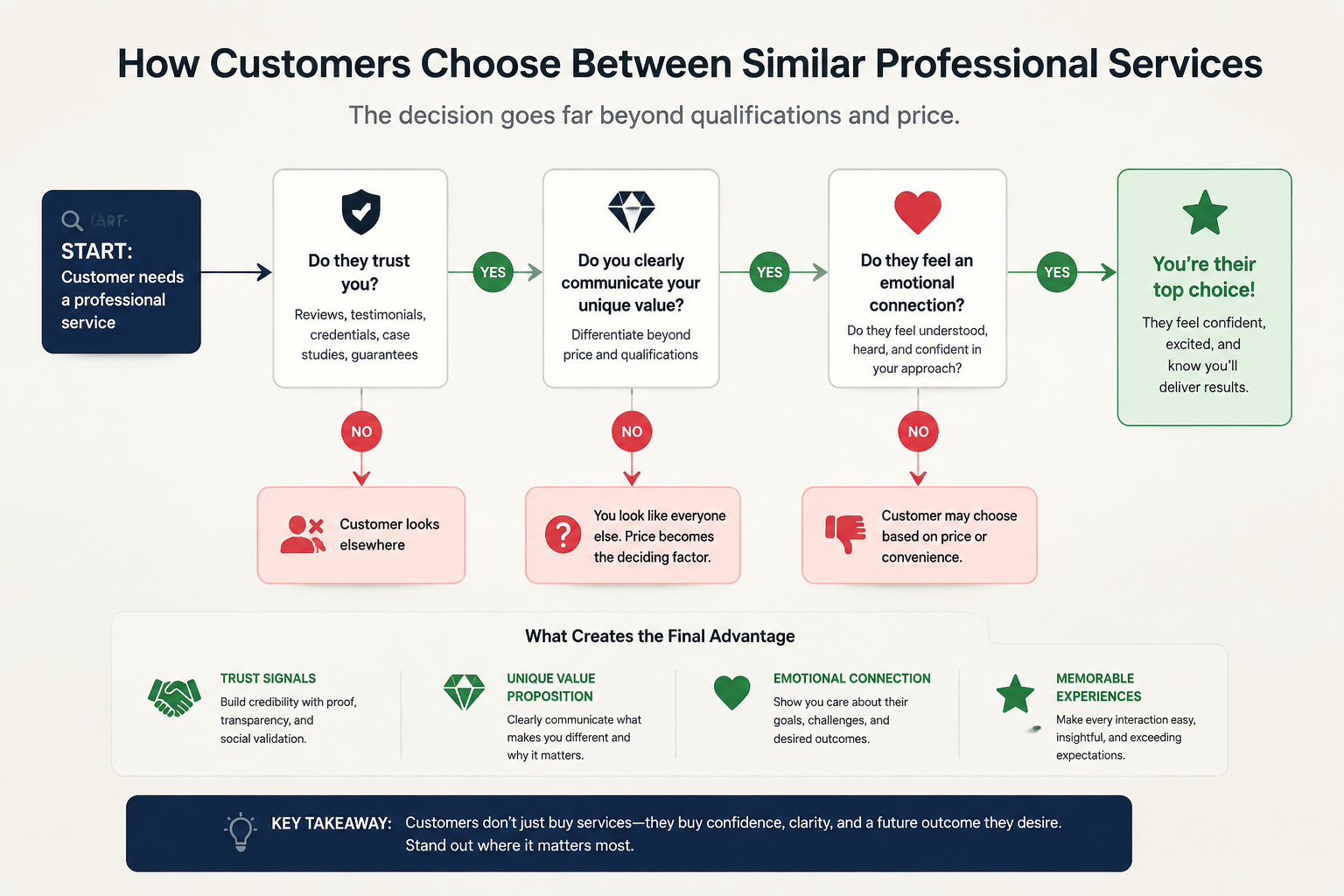
Customers make decisions based on trust, emotional connection, and perceived value rather than professional credentials alone. After analyzing hundreds of client interactions through our automated follow-up systems, we’ve identified the key factors that actually drive purchase decisions.
Trust Signals Beyond Credentials
Professional certifications establish baseline credibility, but prospects look for deeper trust indicators:
- Transparent communication about pricing, timelines, and potential challenges
- Relevant case studies that mirror their specific situation
- Accessible expertise demonstrated through helpful content and quick responses
- Social proof from clients who faced similar problems
Emotional Resonance
People buy from businesses they feel understand their specific challenges. A generic “we help small businesses” message creates no emotional connection. But “we help overwhelmed restaurant owners who are tired of juggling five different software systems” immediately resonates with the right prospects.
Our clients who embrace this approach see dramatic improvements in conversion rates. One IT consultant stopped talking about “managed services” and started positioning himself as “the IT guy who fixes problems before they break your business.” His close rate doubled because prospects felt he understood their fear of unexpected downtime.
Perceived Value Alignment
Customers choose businesses whose approach matches their preferences and values:
- Communication style – Some prefer detailed technical explanations, others want simple summaries
- Service delivery – Some value premium white-glove service, others prefer efficient self-service options
- Business philosophy – Environmental consciousness, community involvement, or innovation focus
The key is being intentionally clear about your approach so the right prospects self-select while others move on to competitors who are better fits for their preferences.
What Makes a Service Memorable Beyond Just Being Competent
Memorable services create experiences that prospects talk about and remember weeks later, while competent services simply meet expectations without leaving lasting impressions. The difference lies in intentional experience design rather than accidental moments of excellence.
Unexpected Value Delivery
The most memorable businesses provide value before being asked or paid. This might include:
- Educational content that solves immediate problems prospects face
- Free tools or resources that demonstrate your expertise and approach
- Proactive communication about industry changes that affect their business
- Personalized insights based on their specific situation during initial conversations
We built this principle into our done-for-you system by creating automated sequences that deliver valuable content to prospects even if they never become clients. This approach keeps our clients top-of-mind while competitors fade into background noise.
Distinctive Communication Style
Your communication style becomes part of your brand when it’s consistent and authentic. Consider these examples from our client base:
- A business coach who sends weekly “Monday Motivation” emails with specific action items
- An accountant who explains tax strategies using sports analogies
- A consultant who provides “Friday Five” lists of quick wins clients can implement immediately
Systematic Follow-Through
Memorable businesses have systems that ensure consistent experiences rather than relying on individual effort alone. Our AI-powered lead capture and automated follow-up systems help clients maintain this consistency while allowing their personality to shine through personalized touchpoints.
The businesses that become truly memorable combine systematic reliability with authentic personality. They’re remembered not just for what they delivered, but for how they made clients feel throughout the entire experience.
What Are the Biggest Mistakes Professionals Make When Trying to Win Clients
The biggest mistake professionals make is trying to appeal to everyone instead of clearly positioning themselves for their ideal clients, which dilutes their message and makes them forgettable in a crowded marketplace. We see this pattern repeatedly when new clients come to us frustrated with poor conversion rates despite having solid credentials and professional presentations.
Generic Positioning That Says Nothing
Most professionals use vague language that could apply to any business in their industry:
- “Full-service marketing solutions”
- “Comprehensive business consulting”
- “Complete financial services”
These phrases tell prospects nothing about what makes you different or why they should choose you over competitors using identical language. Specific positioning like “marketing automation for busy real estate agents” immediately clarifies who you serve and how you help them.
Focusing on Features Instead of Outcomes
Professionals often list their services, certifications, and process steps without connecting them to client results. Prospects don’t care about your methodology until they understand the outcomes you deliver.
Instead of: “We use advanced analytics and proven frameworks to optimize your operations.”
Try: “We help manufacturing companies reduce waste by 30% within 90 days using data-driven process improvements.”
Overcomplicating the Initial Conversation
Many professionals try to demonstrate expertise by explaining complex concepts during initial meetings. This often overwhelms prospects who just want to know if you can solve their problem.
We help our clients avoid this trap by building clear, simple messaging into their automated systems. When prospects receive follow-up emails that address their specific concerns in plain language, they’re more likely to move forward with confidence.
Neglecting Systematic Follow-Up
The most costly mistake is failing to stay in touch with prospects who aren’t ready to buy immediately. Research shows most B2B purchases require multiple touchpoints over weeks or months, but many professionals give up after one or two attempts.
Our automated follow-up systems solve this problem by maintaining consistent contact while providing ongoing value. Prospects receive helpful content, relevant insights, and gentle reminders about your services without requiring manual effort from busy business owners.
Competing on Price Instead of Value
When professionals can’t clearly articulate their unique value, they often resort to competing on price. This creates a race to the bottom that hurts profitability and attracts price-sensitive clients who are difficult to satisfy.
Clear positioning and systematic nurturing help prospects understand your value before price becomes the primary consideration. When they see how your specific approach solves their particular problems, they’re willing to pay premium rates for the right solution.
How Do I Show My Unique Value Instead of Blending Into the Background
Showing unique value requires specific examples and clear differentiation rather than generic claims about quality or service excellence that every competitor also makes. The most effective approach combines strategic positioning with systematic communication that reinforces your distinctive approach.
Document Your Specific Results
Instead of claiming “great results,” provide concrete examples that prospects can relate to their situations:
- “Helped a 15-person consulting firm reduce administrative time by 8 hours per week using automated client onboarding.”
- “Implemented inventory management system that prevented $40K in stockouts for local retailer”
- “Created a marketing system that generated 47 qualified leads in 90 days for a financial advisor.”
These specific examples help prospects visualize similar outcomes for their businesses while demonstrating your expertise in measurable terms.
Develop Signature Frameworks
Create and name your unique approach to solving common problems. This makes your methodology memorable and differentiates you from competitors using generic processes:
- “The 90-Day Profit Recovery System”
- “The Zero-Waste Manufacturing Assessment”
- “The Stress-Free Succession Planning Process”
Named frameworks become intellectual property that competitors can’t easily copy while giving prospects a clear understanding of your structured approach.
Share Behind-the-Scenes Insights
Educate prospects about industry problems they might not recognize or solutions they haven’t considered. This positions you as a trusted advisor rather than just another service provider:
- Weekly emails explaining common mistakes in your industry
- Case studies showing how you solved unexpected challenges
- Educational content about emerging trends that affect their business
Our content creation system helps clients maintain this educational approach by automatically generating relevant topics and organizing them into systematic nurture sequences.
Demonstrate Your Process Transparency
Most professionals keep their methods mysterious, but transparency builds trust and differentiates your approach. Consider sharing:
- Your evaluation criteria for new clients
- Step-by-step explanations of your methodology
- Timeline expectations and milestone markers
- Quality control measures you use
This transparency helps qualified prospects self-select while building confidence in your systematic approach to delivering results.
What Do Customers Really Want That Goes Beyond Basic Professional Service
Customers want confidence that you understand their specific situation and can deliver predictable results without creating additional stress or complications in their already busy lives. This goes far beyond professional competence to include emotional intelligence, systematic reliability, and proactive problem-solving.
Predictable Outcomes and Clear Expectations
Prospects are often burned by previous experiences with professionals who overpromised and underdelivered. They want realistic timelines, transparent pricing, and honest assessments of what you can and cannot accomplish.
Our clients who embrace radical transparency about their process, limitations, and expected outcomes see higher conversion rates than those who make optimistic promises. Prospects appreciate honesty and are more likely to commit when they understand exactly what to expect.
Proactive Communication and Problem-Solving
Customers want professionals who anticipate issues and communicate proactively rather than waiting for problems to escalate. This includes:
- Regular progress updates without being asked
- Early warning about potential challenges or delays
- Suggested solutions when unexpected issues arise
- Educational insights about industry changes that affect their business
Our automated systems help busy professionals maintain this proactive communication without requiring constant manual effort. Clients receive regular updates and valuable insights that keep them informed and confident about their investment.
Simplified Decision-Making
Most customers feel overwhelmed by options and technical complexity. They want professionals who can distill complex information into clear recommendations with simple next steps.
Instead of presenting multiple options with detailed pros and cons, successful professionals provide clear recommendations based on the client’s specific situation and goals. This consultative approach builds trust while making the decision process easier for busy business owners.
Systems That Work Without Constant Oversight
Customers want solutions that improve their business without creating additional management responsibilities. They’re looking for systems and processes that run smoothly with minimal ongoing input from them.
This is why our complete done-for-you system resonates with small business owners. They get a professional website, automated lead capture, and systematic follow-up that works from day one without requiring technical knowledge or constant maintenance.
How Much Does Personality Matter Compared to Technical Skills
Personality matters significantly more than most professionals realize because it determines whether prospects trust you, remember you, and refer others to your business, while technical skills are often assumed to be adequate among qualified professionals. The key is finding the right balance for your target market and industry context.
Personality as a Trust Accelerator
Technical competence gets you considered, but personality determines whether prospects feel comfortable moving forward. Consider these scenarios:
- Two accountants have identical credentials, but one explains tax strategies using everyday examples while the other uses technical jargon
- Both consultants have impressive case studies, but one responds to emails within hours while the other takes days
- Two lawyers have similar experience, but one provides regular updates while the other goes silent between meetings
In each case, personality and communication style become the deciding factors for prospects choosing between technically qualified options.
Industry and Market Context
The importance of personality varies by industry and target market:
High-Personality Industries: Marketing, sales training, executive coaching, creative services, and customer-facing roles where relationship-building is central to success.
Balanced Approach Industries: Management consulting, financial planning, business coaching, and professional services where expertise and rapport are equally important.
Expertise-Heavy Industries: Specialized technical consulting, legal services, and highly regulated fields where credentials and track record carry more weight.
Even in expertise-heavy industries, personality still matters for client retention and referrals. Technical competence might win the initial contract, but personality determines long-term relationships and word-of-mouth marketing.
Systematic Personality Expression
The most successful professionals develop systems that consistently express their personality while maintaining professional standards. This might include:
- Signature communication style in emails and presentations
- Consistent value delivery through educational content and insights
- Authentic storytelling that illustrates expertise through real examples
- Personal touches that make interactions memorable and human
Our platform helps clients systematize their personality expression through customized messaging, automated follow-up sequences, and content that reflects their unique voice and approach.
Are There Industries Where Being Different Matters More Than Being Perfect
Creative services, competitive consulting markets, and relationship-dependent industries reward differentiation more than perfection because clients in these sectors have numerous qualified options and make decisions based on fit and connection rather than credentials alone. However, every industry benefits from strategic differentiation when positioned appropriately.
High-Differentiation Industries
Marketing and Creative Services: Clients expect creativity and fresh thinking, making personality and unique approaches essential differentiators. A marketing consultant who positions themselves as “the strategist who thinks like a customer, not a marketer” immediately stands out from competitors promoting generic marketing expertise.
Business Coaching and Consulting: Success depends on client relationships and trust, making an authentic personality crucial. Coaches who embrace their background – former military officer, ex-corporate executive, recovered perfectionist – create stronger connections than those hiding behind generic professional personas.
Professional Services in Saturated Markets: When prospects can choose from dozens of qualified accountants, lawyers, or consultants, personality and approach become primary differentiators. The accountant who “speaks entrepreneur” or the lawyer who “explains legal stuff in plain English” wins more business than technically superior competitors with bland positioning.
Balanced Approach Industries
Financial Services: Expertise and credentials matter significantly, but personality determines client comfort and retention. Financial advisors who can explain complex concepts simply while demonstrating genuine care for client goals outperform those who rely solely on technical knowledge.
Healthcare and Professional Services: Competence is non-negotiable, but bedside manner and communication style strongly influence client satisfaction and referrals.
Strategic Implementation
Even in conservative industries, differentiation works when positioned appropriately:
- Engineering firms can differentiate on communication clarity and project management approach
- Legal practices can stand out through client education and transparent processes
- Accounting practices can differentiate in responsiveness and plain-English explanations
The key is understanding your market’s tolerance for personality while finding authentic ways to stand out within those boundaries. Our systems help clients test different positioning approaches and measure response rates to find the optimal balance for their specific market.
What Signals Do Customers Use to Decide Between Similar Professional Options
Customers rely on trust indicators, communication quality, and perceived cultural fit when choosing between professionally qualified options, often making decisions based on subtle signals that demonstrate competence and compatibility rather than obvious credentials or marketing messages.
Primary Trust Signals
Response Time and Communication Quality: How quickly you respond to initial inquiries and the helpfulness of your responses signal your future availability and service quality. Prospects often eliminate options based on slow or generic initial responses.
Relevant Experience Demonstration: Specific examples that mirror their industry, company size, or challenge type carry more weight than impressive but irrelevant case studies. A consultant’s experience helping similar businesses matters more than their total years of experience.
Social Proof Alignment: Testimonials and references from recognizable companies or similar situations provide stronger validation than generic positive reviews. Prospects look for evidence that you’ve successfully helped businesses like theirs.
Professional Presentation Consistency: Your website, email communications, and initial meetings should reflect consistent attention to detail and quality standards. Inconsistency raises questions about your systematic approach to client work.
Secondary Decision Factors
Process Transparency: Prospects favor professionals who clearly explain their methodology, timeline, and expected outcomes over those who keep their process mysterious. Transparency suggests confidence and a systematic approach.
Educational Value: Professionals who provide helpful insights during initial conversations demonstrate expertise while building trust. This might include industry observations, relevant resources, or strategic questions that help prospects think differently about their challenges.
Cultural and Communication Fit: Prospects evaluate whether your communication style, pace, and approach align with their preferences. Some prefer detailed analysis while others want quick summaries. Some value formal presentations while others prefer conversational discussions.
Systematic Signal Management
Our automated systems help clients consistently send positive signals through:
- Immediate response to inquiry forms with helpful next steps
- Relevant content delivery based on prospect interests and industry
- Consistent follow-up that provides value without being pushy
- Professional presentation across all touchpoints and communications
When these signals align consistently, prospects develop confidence in your systematic approach to client service before they even become clients.
How Can Small Businesses Compete Against Big Corporate Competitors