
Contact Form Leads: What Happens Next & How to Convert
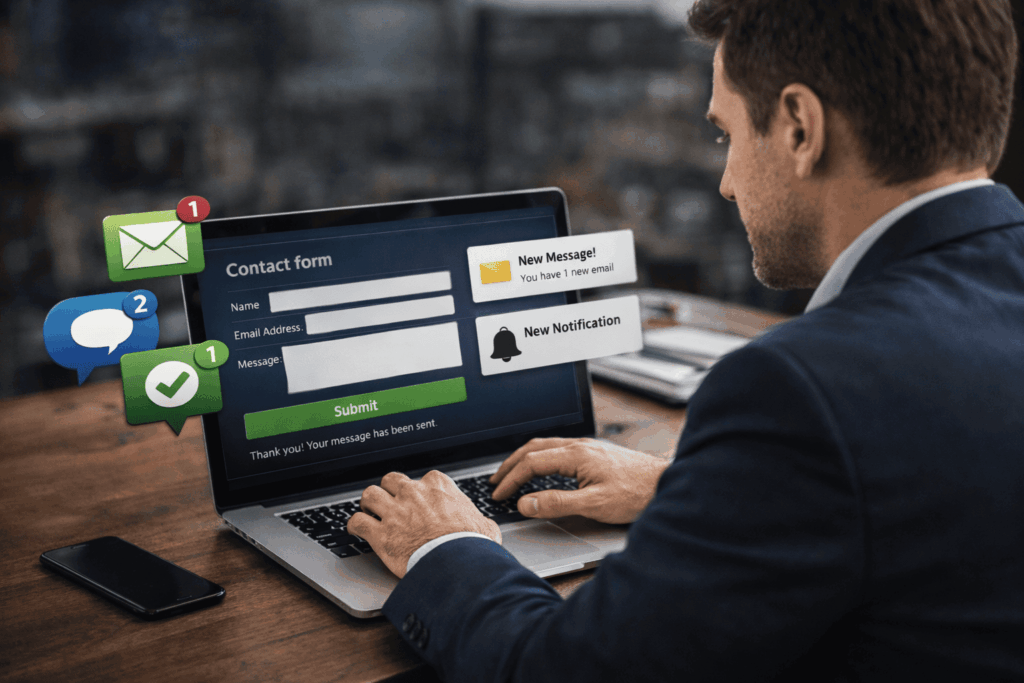
Picture this: Sarah, a marketing director at a growing Atlanta consulting firm, just spent 20 minutes researching your services. She’s impressed with your case studies and thinks you might be the perfect fit for her upcoming project. She fills out your contact form, hits submit, and then… nothing.
No confirmation message. No immediate email. Just a generic “thank you” page that leaves her wondering if her inquiry actually went through. Three days later, when your sales rep finally calls, Sarah has already moved on to a competitor who responded within an hour.
This scenario plays out thousands of times every day across small businesses. You’ve invested in a website, created compelling content, and successfully attracted interested prospects. But what happens after someone submits your contact form often determines whether that lead becomes a customer or disappears forever.
What Your Prospects Experience in Those First Critical Minutes
Your prospects go through a predictable emotional journey after hitting “submit” on your contact form. Understanding this journey is the first step to improving your website inquiry follow-up process.
Within the first 60 seconds, prospects experience what we call “submission anxiety.” They’re wondering:
- Did my form actually submit?
- Will someone really get back to me?
- How long will I have to wait?
- Did I provide enough information?
- Should I fill out forms on other websites, too?
This anxiety intensifies if they don’t receive immediate confirmation. We’ve seen this firsthand with our clients: prospects who don’t receive instant acknowledgment are 70% more likely to submit forms to competitors the same day.
The uncertainty factor grows exponentially with time. After 24 hours without contact, prospects start questioning whether your business is even operational. After 48 hours, they’ve likely engaged with competitors. After a week, they’ve probably decided without you.
Here’s what’s happening in their mind during those crucial first hours:
Hour 1: “I hope they get back to me soon. This looks like a good fit.”
Hour 6: “Maybe I should check my spam folder. Or try calling directly.”
Day 1: “I should probably reach out to a few other companies too, just in case.”
Day 3: “Well, I guess they’re not interested in my business.”
The emotional journey from interest to disappointment happens faster than most business owners realize. That’s why your contact form conversion rate depends heavily on what happens in those first few minutes and hours.
The Hidden Costs of Poor Website Lead Response
Every delayed response costs you more than just one potential customer. The ripple effects of poor contact form lead management extend far beyond individual lost sales.
Consider the real financial impact. If your average customer is worth $10,000 and you receive 20 contact form submissions per month, losing even 30% due to poor follow-up costs you $60,000 annually. For many small businesses, that’s an entire employee’s salary.
But the costs go deeper than immediate lost revenue:
Reputation damage spreads quickly. In 2026, prospects share their experiences online more than ever. A frustrated potential customer might post about your poor responsiveness on LinkedIn, Google reviews, or industry forums. One negative review about unresponsiveness can deter dozens of prospects.
Referral opportunities disappear. Even prospects who don’t buy from you can become referral sources if you handle their inquiry professionally. Poor follow-up eliminates these relationship-building opportunities.
Marketing ROI plummets. You’re spending money on SEO, content marketing, and advertising to drive traffic to your website. When contact form leads slip through the cracks, you’re essentially throwing that marketing investment away.
Team morale suffers. Sales teams get frustrated when they discover week-old leads that are no longer interested. Marketing teams question the quality of their efforts when conversion rates stay low despite generating plenty of inquiries.
We worked with an Atlanta-based professional services firm that was generating 40 quality leads per month but closing only 2-3 deals. They blamed their pricing, their competition, and even their website design. The real problem? Their contact form submissions were going to an inbox that someone checked twice a week.
Once we implemented an automated follow-up system with immediate confirmation emails and same-day phone outreach, their close rate tripled without changing anything else about their business.
How to Create an Immediate Response System That Actually Works
The best contact form conversion systems combine automation with human touch to create seamless prospect experiences. Here’s exactly how to build a system that captures and nurtures leads automatically.
Step 1: Instant Confirmation Email
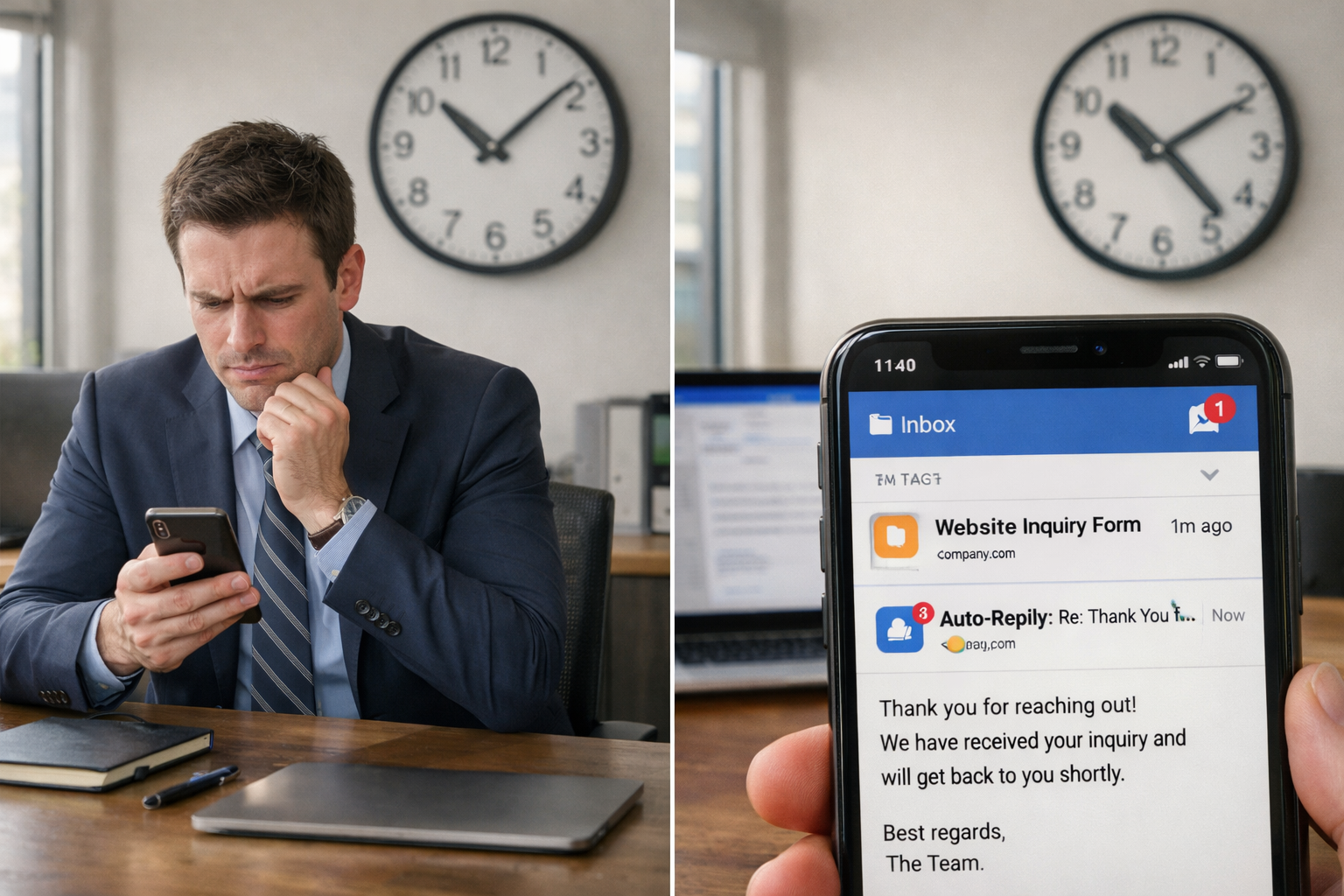
Your confirmation email should arrive within 60 seconds of form submission. This isn’t just about technology – it’s about psychology. Immediate confirmation transforms anxiety into anticipation.
Your confirmation email must include:
- Clear acknowledgment that you received their inquiry
- Specific timeline for when they’ll hear from someone personally
- Next steps they can expect in the process
- Direct contact information in case they have urgent questions
- Relevant resources that add value while they wait
Here’s an example that works:
“Hi [Name], Thanks for reaching out about [specific service]. I received your inquiry about [their specific need] and will personally review your information today. You’ll hear from me by phone tomorrow morning between 9 and 11 AM to discuss your project in detail. In the meantime, here’s a case study of how we helped [similar company] achieve [specific result]. Looking forward to our conversation! [Your name and direct phone].”
Step 2: Personal Outreach Within 24 Hours
Automated emails buy you time, but human contact closes deals. Your personal outreach should happen within 24 hours maximum – ideally within 4-6 hours during business days.
When you call or email personally:
- Reference specific details from their form submission
- Ask clarifying questions about their needs
- Offer immediate value or insights
- Suggest a specific next step (meeting, proposal, consultation)
- Follow up in writing to confirm any verbal commitments
Step 3: Structured Follow-Up Sequence
Not every prospect will be ready to engage immediately. A structured follow-up sequence keeps you top-of-mind without being pushy.
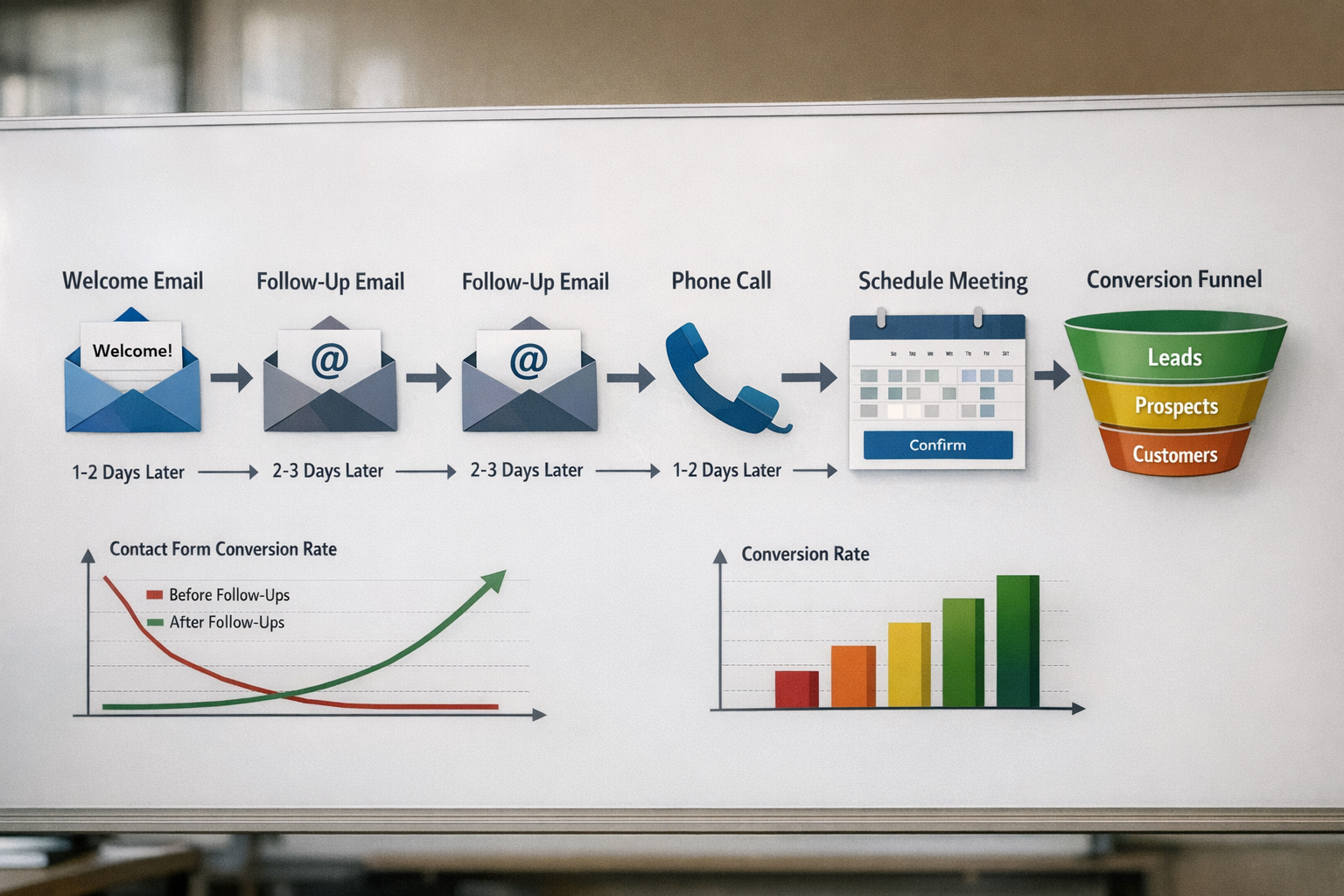
Day 1: Personal phone call and follow-up email
Day 3: Helpful resource related to their inquiry
Day 7: Case study or success story relevant to their situation
Day 14: Industry insights or market update
Day 30: Check in with new service offerings or seasonal relevance
Step 4: Multiple Communication Channels
Different prospects prefer different communication methods. Your system should accommodate various preferences:
- Email for detailed information and documentation
- Phone calls for immediate questions and relationship building
- Text messages for quick confirmations and reminders
- LinkedIn for professional service businesses
- Video messages for high-value prospects
The key is asking prospects how they prefer to communicate and then honoring that preference consistently.
Building Systems That Actually Work for Your Business
The difference between businesses that convert contact form leads and those that don’t comes down to having systems that actually work. Most small businesses try to manage inquiries manually, which works fine until it doesn’t.
Manual processes fail because they depend on perfect human behavior. Someone forgot to check their email over the weekend. A team member goes on vacation. A busy week causes follow-ups to slip through the cracks. Suddenly, qualified prospects are waiting days for responses.
That’s why we build complete done-for-you systems for our clients. Instead of giving you another tool to learn, we create the entire lead capture and nurturing process for you. Your free smart website built for you includes AI-powered lead capture forms that integrate seamlessly with automated follow-up systems.
Here’s what makes our approach different:
We build the website and content specifically for lead generation. Your site isn’t just pretty – it’s designed to convert visitors into contact form leads through strategic placement of forms, compelling calls-to-action, and trust-building elements.
Automated follow-up systems work from day one. No tech knowledge required on your part. Leads are captured and nurtured automatically while you focus on running your business and closing deals.
Everything works together in one platform. No juggling multiple tools or trying to make different systems talk to each other. Your all-in-one platform handles everything from initial contact through final sale.
Ready from day one. While other solutions require weeks of setup and learning, our systems that actually work are built and implemented for your business immediately.
The Psychology of Following Up Without Being Annoying
Effective website inquiry follow-up requires understanding the fine line between persistence and pushiness. Most business owners either give up too quickly or become so aggressive that they drive prospects away.
The secret is providing value with every touchpoint. Instead of just checking in to see if they’re ready to buy, each follow-up should offer something useful:
- Industry insights they might not have considered
- Solutions to the problems they mentioned in their initial inquiry
- Case studies of similar businesses you’ve helped
- Resources that help them make better decisions (even if they don’t choose you)
Timing matters as much as content. Space your follow-ups strategically:
- Immediate: Confirmation and acknowledgment
- Same day: Personal outreach and conversation
- 3 days later: Additional resources or answers to questions
- 1 week later: Relevant case study or success story
- 2 weeks later: Industry update or market insight
- 1 month later: New offerings or seasonal check-in
This approach keeps you visible without being overwhelming. Prospects appreciate the valuable information, and you stay top-of-mind for when they’re ready to move forward.
Always give them an easy way out. Include unsubscribe options and respect communication preferences. Paradoxically, giving prospects control over the conversation often makes them more likely to engage.
Measuring and Improving Your Contact Form Conversion Process
What gets measured gets improved. Tracking the right metrics helps you identify exactly where your contact form leads process needs attention.
Key metrics to monitor:
Response time: How quickly do you acknowledge and personally respond to inquiries?
Conversion rate: What percentage of contact form submissions become qualified opportunities?
Follow-up completion rate: Are you consistently executing your follow-up sequence?
Source tracking: Which marketing channels generate the highest-quality contact form leads?
Time to close: How long does it take to move from initial inquiry to closed deal?
Most small businesses don’t track these metrics because they’re too busy managing the day-to-day chaos of scattered tools and manual processes. That’s exactly why our predictable growth system includes built-in analytics and reporting.
You can see exactly which leads came from where, how quickly you responded, and which follow-up messages generated the most engagement. This data helps you continuously improve your approach without guessing what’s working.

Common Mistakes That Kill Contact Form Conversions
Even businesses with good intentions often make critical errors that sabotage their website lead response efforts. Here are the most common mistakes we see and how to avoid them:
Mistake #1: Generic confirmation messages
Sending the same confirmation email to everyone, regardless of their specific inquiry. Prospects can tell when you’re not paying attention to their individual needs.
Fix: Customize confirmation emails based on the service they inquired about and reference specific details from their form submission.
Mistake #2: Waiting for the “perfect” time to respond
Thinking you need to have all the answers before reaching out. Prospects prefer quick acknowledgment over perfect information.
Fix: Respond quickly with what you know and schedule a follow-up conversation to dive deeper into their needs.
Mistake #3: One-size-fits-all follow-up sequences
Using the same follow-up approach for every prospect, regardless of their industry, company size, or specific needs.
Fix: Segment your follow-up sequences based on prospect characteristics and tailor your messaging accordingly.
Mistake #4: Giving up too soon
Assuming prospects aren’t interested if they don’t respond to your first or second outreach attempt.
Fix: Implement a longer-term nurturing sequence that provides value over time, even if prospects aren’t ready to buy immediately.
Mistake #5: Making it all about you
Focusing your follow-up messages on your services, your company, and your needs instead of their challenges and goals.
Fix: Lead with their interests and frame your capabilities in terms of solving their specific problems.
Creating a Predictable System for Sustainable Growth
The goal isn’t just to improve your current contact form leads process – it’s to create a system that generates predictable growth month after month. This requires thinking beyond individual inquiries to building a comprehensive lead generation and nurturing machine.
Successful businesses in 2026 don’t rely on manual effort or hope that prospects will wait patiently for responses. They implement automated systems that work consistently, regardless of how busy things get or who’s in the office.
This is exactly what we do for our clients in the Metro Atlanta area. Instead of teaching you how to build these systems yourself, we create the complete done-for-you system that starts working immediately.
Your leads are captured and nurtured automatically through our AI-powered lead capture system. Follow-up sequences are personalized and timely. Nothing falls through the cracks because the system handles the details while you focus on what you do best – running your business and serving customers.
The result? Predictable lead flow, higher conversion rates, and the confidence that comes from knowing your marketing and sales processes are working even when you’re not actively managing them.
Frequently Asked Questions
How quickly should I respond to contact form submissions?
Aim for immediate confirmation (within 60 seconds) and personal outreach within 4-6 hours during business days. Studies show that response time directly correlates with conversion rates – the faster you respond, the higher your chances of converting the lead.
What should I include in my confirmation email?
Include acknowledgment of their specific inquiry, timeline for personal follow-up, next steps they can expect, your direct contact information, and relevant resources that add value while they wait.
How many follow-up attempts should I make?
Plan for at least 5-7 touchpoints over 30 days, but focus on providing value rather than just checking in. Each follow-up should offer something useful – insights, resources, or solutions to problems they mentioned.
Should I use automated emails or personal outreach?
Use both. Automated confirmation emails provide immediate acknowledgment, while personal outreach builds relationships and closes deals. The best systems combine automation for consistency with human touch for conversion.
What if prospects don’t respond to my follow-up efforts?
Continue providing value through longer-term nurturing sequences. Not every prospect is ready to buy immediately, but consistent value-driven communication keeps you top-of-mind for future opportunities.
How can I track the effectiveness of my follow-up process?
Monitor response times, conversion rates, follow-up completion rates, source tracking, and time to close. Most businesses need integrated systems that track these metrics automatically rather than manual spreadsheet tracking.
What’s the biggest mistake businesses make with contact form leads?
The biggest mistake is treating all inquiries the same way instead of personalizing responses based on specific needs and circumstances. Generic follow-up sequences feel impersonal and reduce conversion rates significantly.
How do I avoid being too pushy in my follow-up?
Focus on providing value with every touchpoint rather than just asking for a sale. Share relevant insights, case studies, and resources that help prospects make better decisions, even if they don’t choose your services.
Should I follow up by phone, email, or both?
Use multiple channels based on prospect preferences. Start with email for documentation and phone for immediate questions, but ask prospects how they prefer to communicate and honor those preferences.
What if I don’t have time to manage follow-up sequences manually?
Implement automated systems that handle the process for you. The most successful businesses use integrated platforms that capture leads and nurture them automatically while maintaining a personal touch.
How long should I continue following up with prospects?
Maintain long-term nurturing sequences for qualified prospects who aren’t ready to buy immediately. Some deals take months to develop, so consistent value-driven communication over time often generates better results than aggressive short-term follow-up.
What’s the ROI of improving my contact form response process?
Most businesses see a 2-3x improvement in conversion rates when they implement structured follow-up systems. For a business receiving 20 leads per month with a $10,000 average deal size, improving conversion from 10% to 30% adds $240,000 in annual revenue.
Conclusion
What happens after someone submits your contact form determines whether that prospect becomes a customer or disappears to a competitor. The businesses that thrive in 2026 understand that fast, personalized, value-driven follow-up isn’t optional – it’s essential for sustainable growth.
Most small business owners know they should respond quickly to inquiries, but knowing and doing are two different things. Manual processes fail when life gets busy. Scattered tools create gaps where leads slip through. Generic follow-up sequences feel impersonal and reduce conversion rates.
The solution isn’t trying harder with the same broken processes. It’s implementing systems that actually work – automated confirmation emails, structured follow-up sequences, and integrated platforms that handle the details while you focus on running your business.
We’ve seen this transformation countless times with our clients. Businesses that were losing 70% of their contact form leads due to poor follow-up now convert 3x more prospects into customers. The difference isn’t their pricing, their services, or their competition – it’s having systems that capture and nurture leads automatically.
If you’re tired of watching qualified prospects slip away due to delayed responses and inconsistent follow-up, it’s time to implement a system that works from day one. Your prospects are ready to engage – the question is whether your business is ready to respond.
Ready to transform how you handle contact form leads? Let’s build a system that actually works for your business. Schedule a free consultation to see how our done-for-you platform can automate your lead capture and follow-up process starting today.

