
Why Small Business Websites Look Good but Don’t Convert
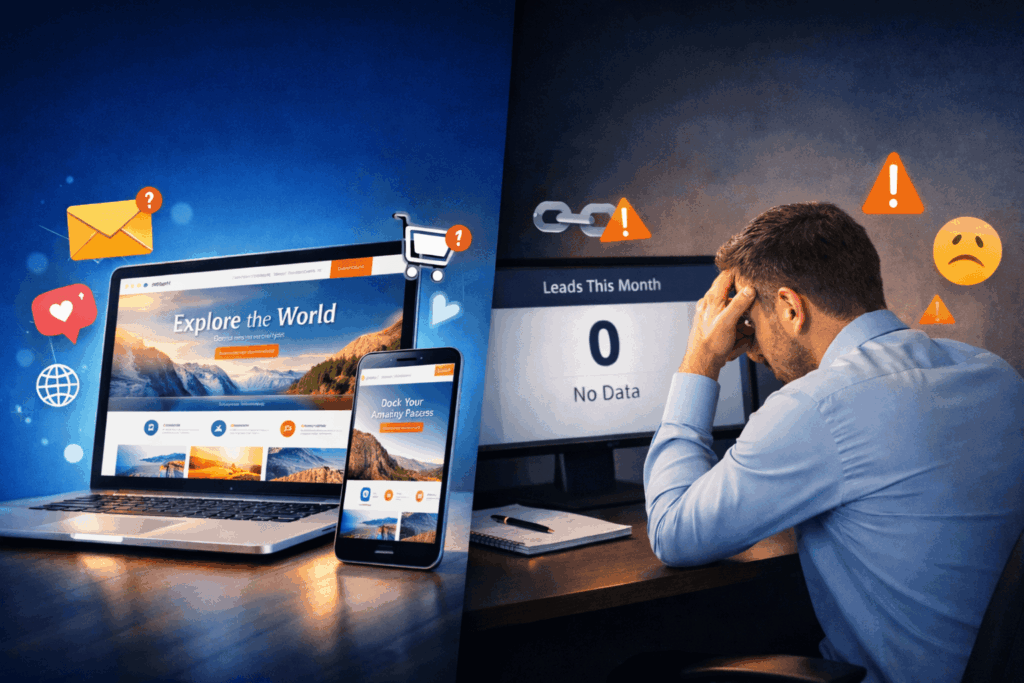
The Great Website Design vs Conversion Divide
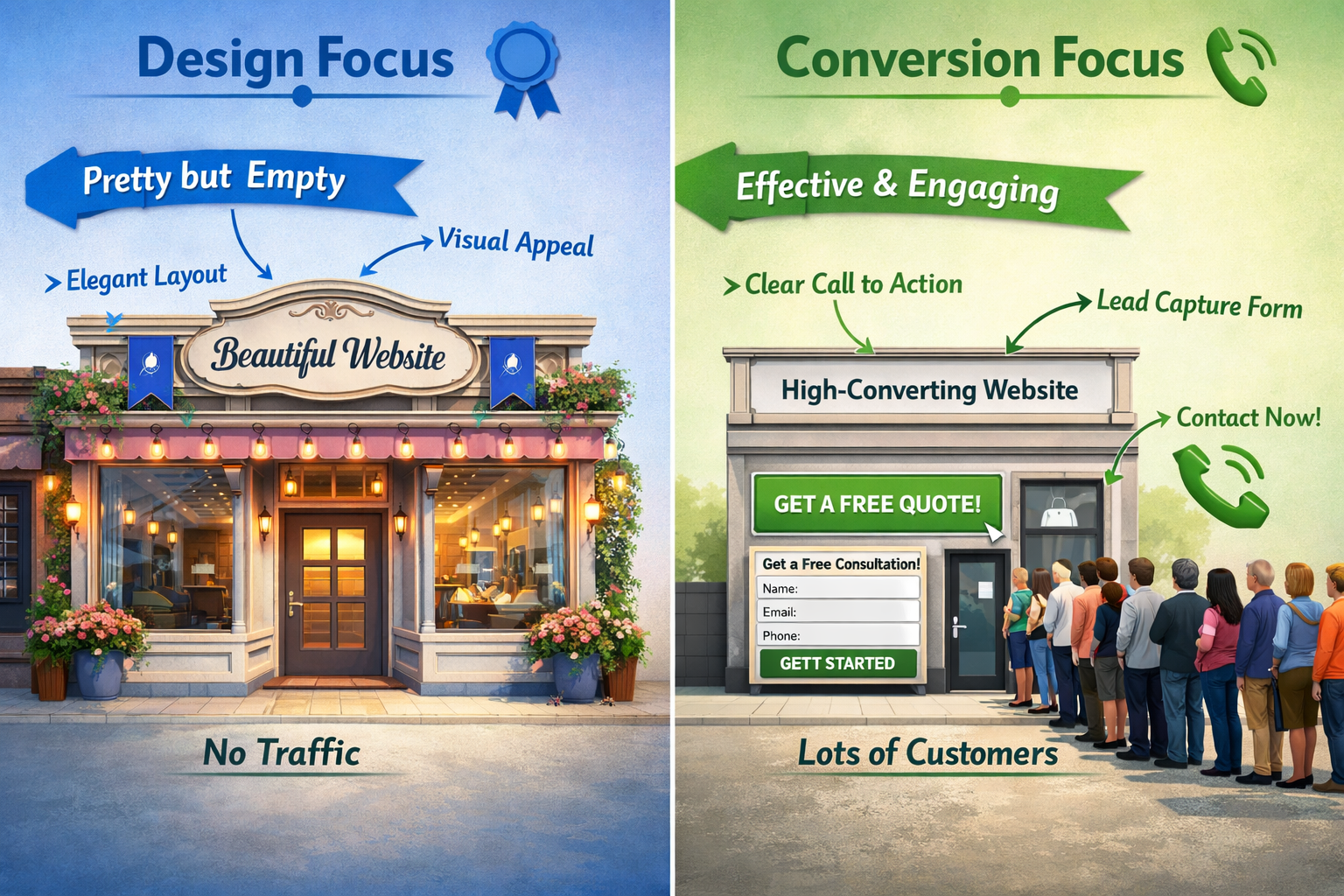
Here’s what happened to Sarah, who runs a marketing consultancy in Atlanta. She hired a top-tier design agency and spent $15,000 on a website that resembled a design portfolio. Six months later, she was getting maybe one inquiry per month from her site.
When we analyzed her low-converting website, the problems became crystal clear. Her homepage had a gorgeous hero image and the tagline “Innovative Marketing Solutions for Forward-Thinking Companies.” Sounds impressive, right? But visitors had no idea what she actually did or who she helped.
This is the classic website design vs conversion problem. Designers often prioritize aesthetics over business outcomes. They’re trained to create visual appeal, rather than understanding buyer psychology or lead generation principles.
Why Design-First Thinking Fails Your Business
Most web designers approach projects like artists creating a masterpiece. They focus on:
- Visual hierarchy that looks good in screenshots
- Brand consistency that impresses other designers
- Creative elements that showcase their skills
- Industry trends that win awards
But your potential customers don’t care about any of that. They visit your website with specific problems and questions:
- Can this company solve my problem?
- Do they understand my situation?
- What exactly do they do?
- How do I get started?
- Can I trust them?
When your website doesn’t answer these questions clearly and quickly, visitors leave. It doesn’t matter how beautiful your site looks if it’s not built to capture and nurture leads.
The Real Cost of Pretty but Pointless Websites
Let’s talk numbers. If your website gets 1,000 visitors per month but only converts 0.5% of them into leads, you’re getting 5 leads monthly. A conversion-focused website with the same traffic might convert 3-5%, generating 30-50 leads.
That’s not just a small difference; it’s the difference between struggling to grow and having more opportunities than you can handle.
We’ve seen businesses transform their results simply by shifting from design-focused to conversion-focused thinking. One client went from 2 leads per month to 25 leads per month with the same website traffic, just by implementing the principles we’ll cover in this article.
The Messaging Maze: When Your Website Speaks in Riddles
Walk through this exercise with me. Visit your website and read your homepage out loud. Now ask yourself: Would a stranger understand exactly what you do and who you help within 10 seconds?
If you’re like most business owners, the answer is probably no. And that’s your first major website conversion problem.
The Jargon Trap
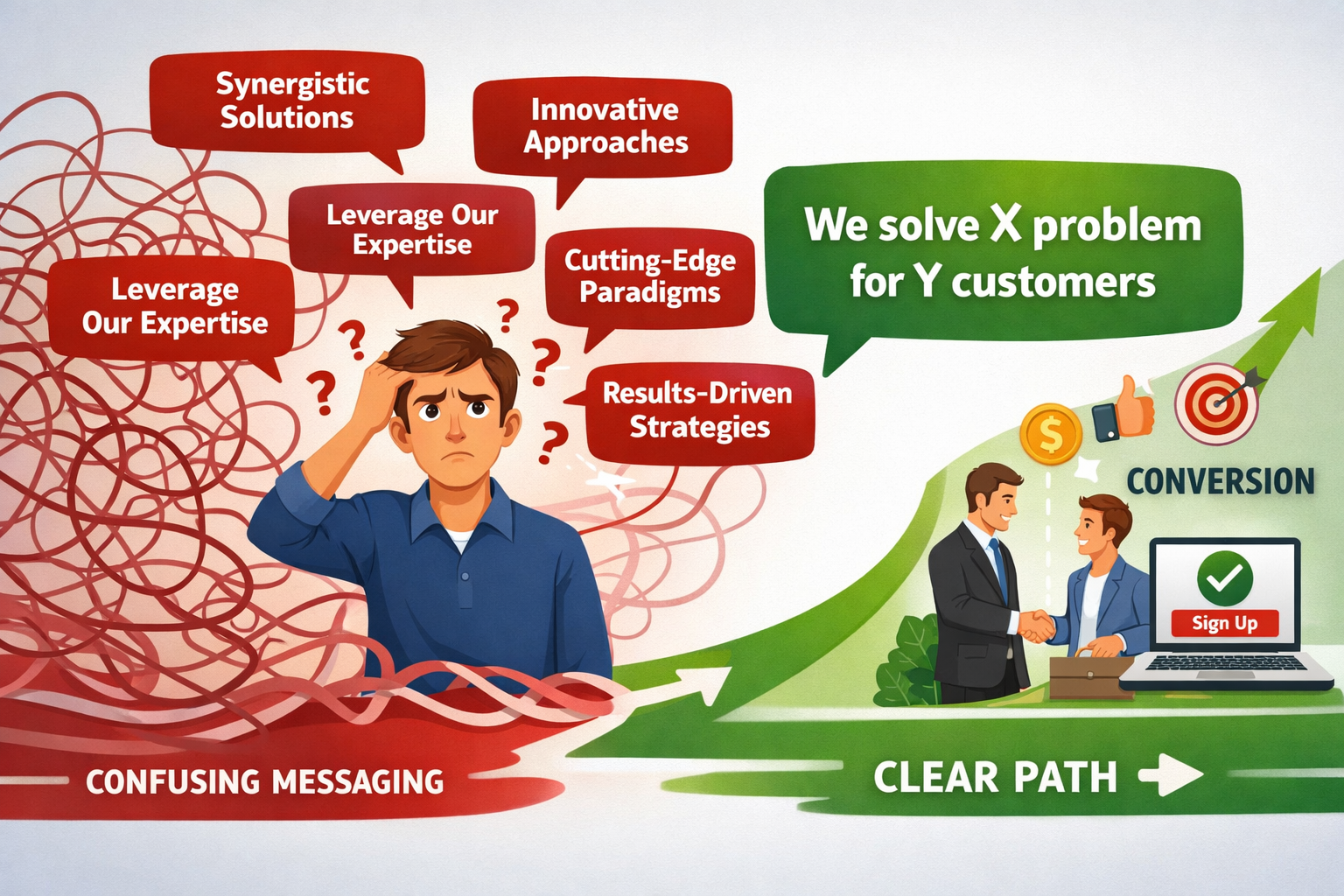
Business owners love industry jargon. It makes them feel smart and professional. But jargon is conversion poison. When your website says you provide “synergistic solutions” or “innovative approaches,” you’re not communicating, you’re confusing.
I recently reviewed a website for an IT services company. Their headline read: “Leveraging cutting-edge technology solutions to optimize your digital infrastructure and enhance operational efficiency.”
What does that actually mean? Nothing specific. Compare that to: “We keep your computers running so you can focus on your business.” Simple, clear, and immediately understandable.
The Curse of Knowledge
You know your business inside and out. You understand every service, every benefit, every technical detail. But your website visitors don’t. They’re coming to your site with a problem, not an MBA in your industry.
This creates what psychologists call the “curse of knowledge”; you can’t remember what it’s like not to know what you know. So you write copy assuming visitors understand your industry, your processes, and your value proposition.
Clear Messaging That Converts
Effective website messaging follows a simple formula:
We help [specific type of customer] [achieve specific outcome] by [your unique method].
For example:
- “We help manufacturing companies reduce equipment downtime by 40% through predictive maintenance programs.”
- “We help law firms double their case volume through automated lead generation systems.”
- “We help restaurants increase takeout orders by 60% with optimized online ordering systems.”
Notice how each example immediately tells you:
- Who they serve
- What result they deliver
- How they’re different
The 10-Second Test
Your website messaging should pass the 10-second test. A visitor should be able to land on your homepage and, within 10 seconds, understand:
- What you do
- Who you help
- What makes you different
- What they should do next
If your messaging doesn’t pass this test, you’re losing leads every day.
Speaking Your Customer’s Language
Stop talking about your services and start talking about your customers’ problems. Instead of “We provide comprehensive digital marketing services,” try “Tired of marketing that doesn’t bring in customers?”
We worked with a commercial cleaning company whose original headline was “Professional Janitorial Services for Commercial Facilities.” Their new headline? “Your office is cleaned perfectly, every time, guaranteed.” Same service, completely different impact.
The second version speaks to what business owners actually care about: reliability, quality, and peace of mind.
The Silent Website Syndrome: Missing Calls-to-Action
Here’s a question that reveals everything about your website’s effectiveness: What specific action do you want visitors to take when they land on your homepage?
If you can’t answer that immediately and specifically, you’ve found another major reason why your small business website is not generating leads.
The Multiple Choice Problem
Most business websites suffer from what I call “multiple choice paralysis.” They offer visitors too many options:
- Learn about our services
- Read our blog
- View our portfolio
- Meet our team
- Contact us
- Download our brochure
- Schedule a consultation
- Get a quote
When everything is a priority, nothing is a priority. Visitors get overwhelmed and choose the easiest option: leaving.
The Power of One Primary Action
Conversion-focused websites guide visitors toward one primary action. Everything else is secondary. This doesn’t mean you can only have one button on your site, but it means you should have one main path you want most visitors to follow.
For most B2B service businesses, the primary action should be starting a conversation. Whether that’s:
- Scheduling a consultation
- Requesting a proposal
- Downloading a valuable resource
- Signing up for a free assessment
The key is choosing one and making it the obvious next step throughout your site.
Call-to-Action Best Practices
Effective calls-to-action share several characteristics:
They’re specific and action-oriented:
- “Learn More”
- “Get Your Free Marketing Audit”
They create urgency or value:
- “Contact Us”
- “Schedule Your Free 30-Minute Strategy Session”
They appear multiple times:
Your primary CTA should appear in your header, throughout your content, and in your footer. Don’t make visitors hunt for it.
They stand out visually:
Use contrasting colors and plenty of white space. Your CTA button should be the most obvious clickable element on the page.
The Phone Number Factor
Don’t underestimate the power of a prominent phone number. Many business owners prefer to call rather than fill out forms. Make sure your phone number is:
- Visible in your header
- Clickable on mobile devices
- Local, if you serve a specific area
We’ve seen businesses increase leads by 30% just by making their phone number more prominent.
The Trust Deficit: Why Visitors Don’t Feel Safe
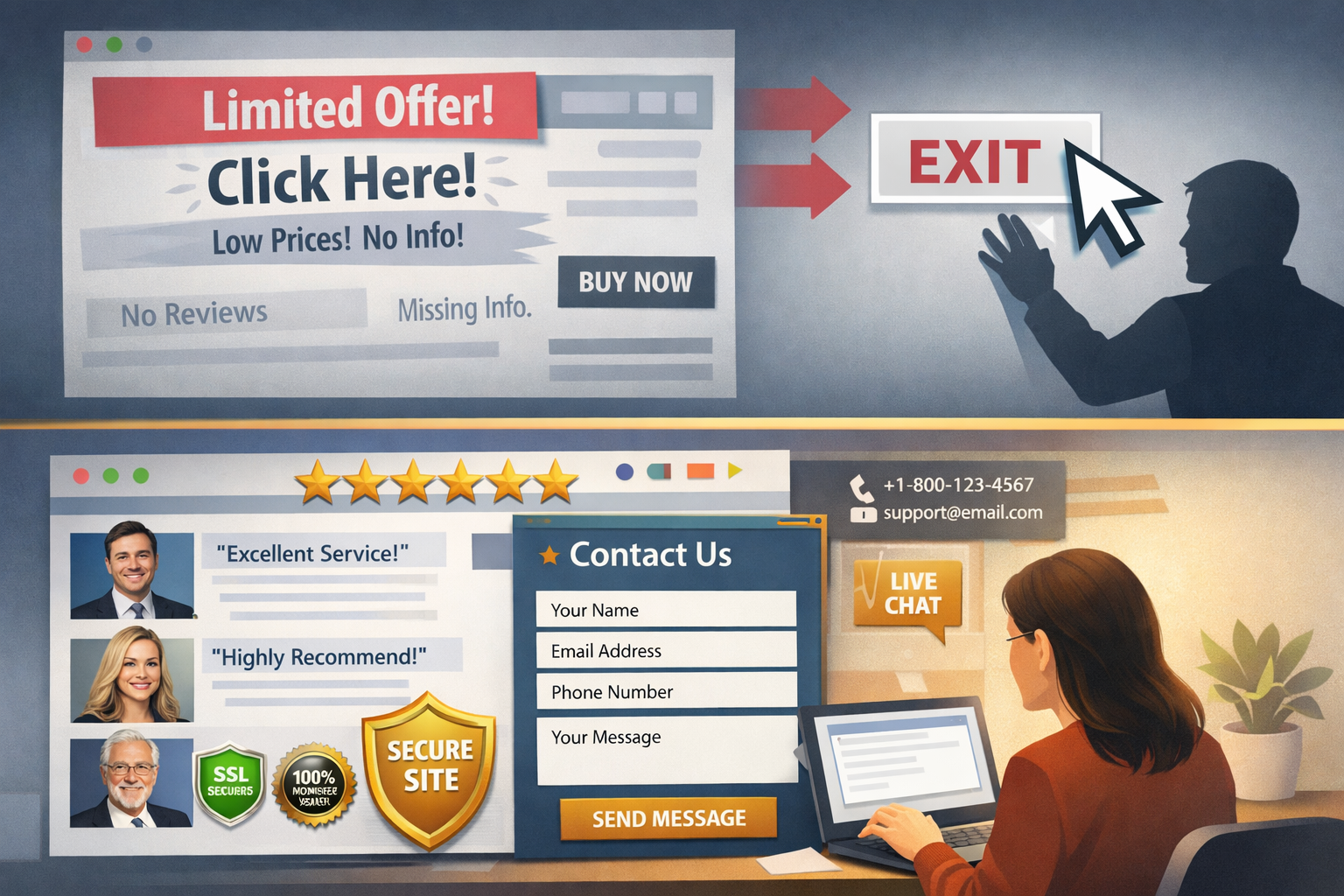
Even if your messaging is clear and your calls-to-action are compelling, visitors still need to trust you before they’ll share their contact information. This is where most beautiful websites fall short; they look professional but don’t build credibility.
The Anonymous Business Problem
Your website might be gorgeous, but if visitors can’t figure out who you are, where you’re located, or how long you’ve been in business, they won’t trust you enough to become leads.
Trust signals are the proof points that convince visitors you’re legitimate, competent, and safe to work with. Without them, even interested prospects will hesitate to reach out.
Essential Trust Signals for B2B Websites
Real photos of real people:
Stock photos of models in suits don’t build trust. Photos of your actual team do. If you’re a solo business owner, include a professional photo of yourself with a brief bio.
Specific location information:
“Serving businesses nationwide” sounds less trustworthy than “Based in Atlanta, serving the Southeast.” Even if you work remotely, having a specific location builds credibility.
Client testimonials with details:
Generic testimonials like “Great service!” don’t work. Effective testimonials include:
- Client’s full name and company
- Specific results or outcomes
- Photo of the client (when possible)
- Details about the project or challenge
Professional credentials and certifications:
Display relevant industry certifications, awards, or professional memberships. These third-party endorsements boost credibility.
Case studies and portfolio pieces:
Show specific examples of your work and the results you’ve achieved. Numbers and concrete outcomes are more persuasive than general descriptions.
Contact information and responsiveness:
Make it easy for visitors to reach you. Include:
- Physical address (even if it’s just your city)
- Phone number
- Email address
- Business hours
- Response time expectations
Social Proof That Converts
The most powerful trust signal is social proof—evidence that other people like them have worked with you successfully. This can include:
Client logos:
Display logos of recognizable companies you’ve worked with (with permission).
Number of clients served:
“We’ve helped over 200 manufacturing companies…” is more compelling than “We help manufacturing companies…”
Years in business:
“Since 2018” or “Over 15 years of experience” provides context for your expertise.
Industry recognition:
Awards, media mentions, or speaking engagements demonstrate third-party validation.
The Security Factor
For B2B websites, security concerns are real. Visitors worry about spam, data breaches, and aggressive sales tactics. Address these concerns directly:
Privacy policy:
Link to a clear privacy policy that explains how you handle contact information.
No spam promises:
“We never share your information” or “Unsubscribe anytime” can reduce form abandonment.
SSL certificates:
Ensure your website has an SSL certificate (the little lock icon in the browser). This is table stakes for credibility.
Professional email addresses:
Emails from [email protected] look more professional than Gmail or Yahoo addresses.
Building Your Lead Generation Machine
Now that we’ve identified the problems, let’s talk solutions. Transforming your website from a digital brochure into a lead generation machine requires strategic thinking, not just design changes.
The Conversion-First Approach
Instead of starting with how your website looks, start with how it works. Ask these questions before you write a single word or choose a single color:
- Who is your ideal customer?
- What problem do they need solved?
- How do they prefer to be contacted?
- What objections do they typically have?
- What proof do they need to trust you?
Once you answer these questions, your website strategy becomes clear.
The Lead Capture Ecosystem
A conversion-focused website isn’t just a collection of pages—it’s an ecosystem designed to capture and nurture leads. This ecosystem includes:
Landing pages optimized for specific audiences:
Instead of trying to appeal to everyone on your homepage, create targeted landing pages for different customer segments or services.
Lead magnets that provide immediate value:
Offer something valuable in exchange for contact information:
- Industry reports
- Checklists or templates
- Free assessments
- Educational webinars
- Strategy guides
Automated follow-up sequences:
What happens after someone fills out your contact form? If the answer is “I manually send them an email,” you’re missing opportunities. Automated follow-up systems ensure no lead falls through the cracks.
Multiple contact options:
Some people prefer forms, others want to call, and some like to schedule meetings directly. Offer multiple ways to start the conversation.
The All-in-One Platform Advantage
Here’s where many businesses get stuck. They try to piece together their lead generation system using multiple tools:
- WordPress for their website
- Mailchimp for email marketing
- Calendly for scheduling
- HubSpot for CRM
- Google Analytics for tracking
Managing all these tools takes time, technical knowledge, and ongoing maintenance. Plus, when they don’t integrate properly, leads get lost, and opportunities slip away.
This is why we built our complete done-for-you system. Instead of forcing business owners to become tech experts, we build the website and content that actually converts. Our AI-powered lead capture and automated follow-up systems work together seamlessly because they’re designed as one integrated platform.
The “Ready from Day One” Difference
Most website projects follow this frustrating timeline:
- Months of back-and-forth on design and content
- Launch day (finally!)
- Weeks of tweaking and fixing issues
- Gradual optimization to improve results
- Maybe start seeing consistent leads after 6+ months
We flip this process. Our predictable growth system is ready from day one because we’ve already tested what works. You don’t need to guess about messaging, experiment with lead magnets, or figure out follow-up sequences. No tech knowledge required—we handle everything.
Measuring What Matters
Beautiful websites often focus on vanity metrics:
- Page views
- Time on site
- Bounce rate
- Design awards
Conversion-focused websites track business metrics:
- Lead generation rate (percentage of visitors who become leads)
- Cost per lead (how much you spend to acquire each lead)
- Lead quality (percentage of leads that become customers)
- Revenue attribution (how much business your website generates)
When you focus on business metrics, you make decisions that improve results, not just aesthetics.
The Path Forward: From Pretty to Profitable
You don’t have to choose between a website that looks good and one that generates leads. The best websites do both. But if you have to prioritize, choose conversion every time. A simple website that generates 20 leads per month beats a beautiful website that generates 2 leads per month.
Quick Wins You Can Implement Today
While a complete website overhaul might take months, you can make improvements that impact your business website leads immediately:
Clarify your headline:
Replace vague taglines with specific statements about what you do and who you help.
Add a prominent phone number:
Make it easy for people to call you, especially on mobile devices.
Create one clear call-to-action:
Choose your primary desired action and make it obvious throughout your site.
Add client testimonials:
Even 2-3 specific testimonials with names and companies can boost credibility.
Include your location:
Local businesses should prominently display their city or service area.
The Long-Term Transformation
For sustainable growth, you need more than quick fixes. You need systems that actually work, a complete ecosystem where leads are captured and nurtured automatically.
This is where most business owners get overwhelmed. Building an effective lead generation system requires:
- Website development skills
- Copywriting expertise
- Email marketing knowledge
- CRM management
- Analytics interpretation
- Ongoing optimization
That’s why we created our complete done-for-you system. Instead of forcing you to become a marketing technologist, we handle everything. You get a free smart website built for you that’s designed from the ground up to generate leads, plus all the backend systems to capture and nurture those leads automatically.
Why DIY Often Fails
I’ve seen countless business owners try to build their own lead generation systems. They start with good intentions, but six months later, they’re frustrated and no closer to consistent lead flow.
The problem isn’t a lack of intelligence or effort. The problem is that effective lead generation requires specialized knowledge across multiple disciplines. Plus, it’s not your core business; you should be focusing on serving customers, not debugging email automation.
Our all-in-one platform eliminates this problem. Everything works together seamlessly because it’s designed as one integrated system, not a collection of separate tools you have to manage.
The Results You Can Expect
When you shift from design-focused to conversion-focused thinking, the results can be dramatic. Here’s what we typically see:
Month 1-2: Immediate improvement in lead capture as messaging becomes clearer and calls-to-action more prominent.
Month 3-4: Increased lead quality as better targeting attracts more qualified prospects.
Month 5-6: Improved conversion rates as trust signals and social proof build credibility.
Month 6+: Predictable lead flow as the entire system optimizes and scales.
The key is having all the pieces work together: clear messaging, compelling offers, trust signals, easy contact methods, and automated follow-up. Miss any piece and the whole system underperforms.
Conclusion
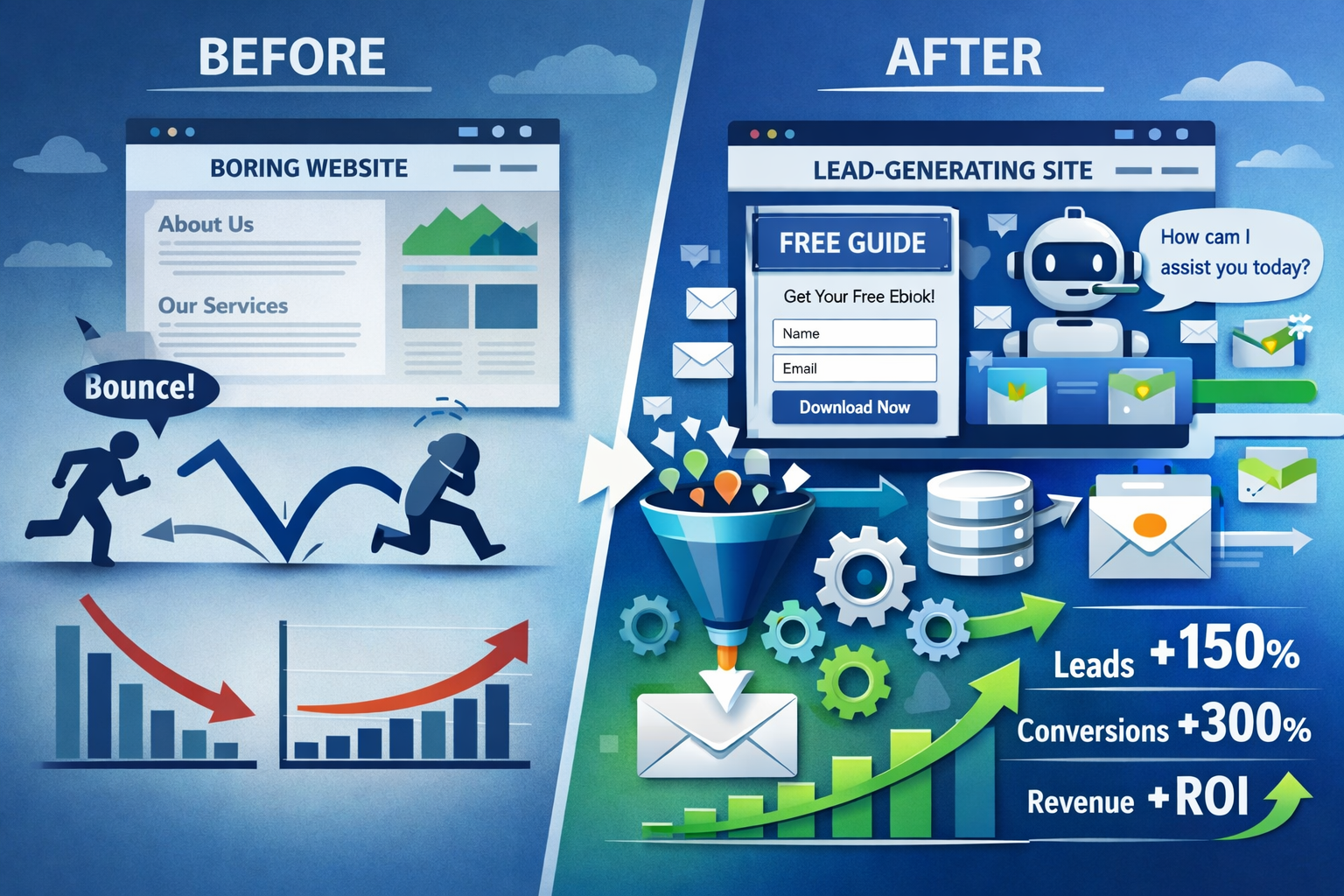
Your website’s job isn’t to win design awards or impress other business owners. Its job is to start conversations with potential customers. If your small business website is not generating leads despite looking professional, you now know why and, more importantly, you know how to fix it.
The transformation from a pretty but pointless website to a lead-generating machine requires strategic thinking, not just design changes. You need:
Clear messaging that immediately tells visitors what you do and who you help
Prominent calls-to-action that guide visitors toward one primary goal
Trust signals that prove you’re credible and competent
Lead capture systems that turn visitors into prospects
Automated follow-up that nurtures leads until they’re ready to buy
Remember Sarah, the marketing consultant we mentioned earlier? After implementing these principles, her monthly leads went from 1 to 15. Same business, same expertise, same market, just a website that actually works for her business instead of against it.
The choice is yours: keep admiring your beautiful website while wondering where your leads are, or transform it into the predictable growth system your business deserves.
Your Next Step
Take an honest look at your website using the principles in this article. Better yet, use our assessment tool above to get a specific score and recommendations.
If you’re ready to stop guessing about what works and start getting consistent leads, we’re here to help. Our team specializes in transforming good-looking websites into lead-generating machines. We build the website and content that actually converts, implement AI-powered lead capture systems, and set up automated follow-up systems that work 24/7.
Ready to see what your website could really do for your business? Let’s schedule a quick conversation to review your current site and show you exactly how to turn it into your best salesperson.

