Is Your Website Costing You Sales? Warning Signs & Solutions
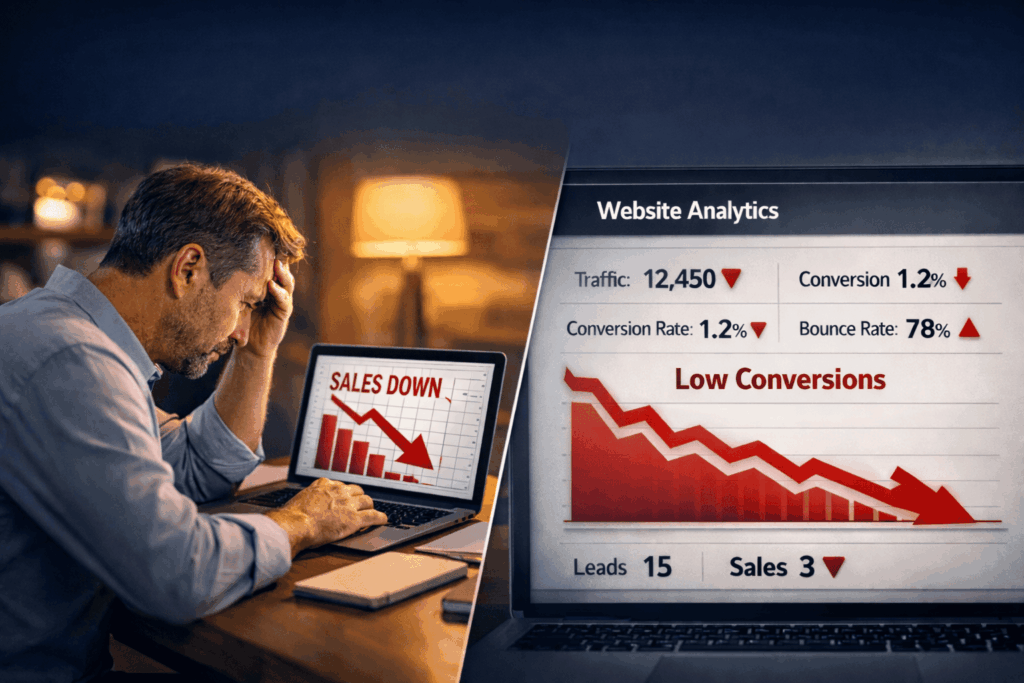
Article Summary

Who this is for: Small to mid-sized business owners who have a professional-looking website but aren’t getting consistent leads or inquiries

The challenge: Hidden website issues like slow load times, poor mobile experience, broken forms, and unclear messaging are silently killing conversions and costing you revenue

Key insights covered: How to identify warning signs of low conversion rates, the most common website mistakes that hurt sales, real-world examples of small fixes creating 200%+ improvements, and how automated lead capture systems recover lost opportunities

Your outcome: A clear understanding of whether your website is hurting your business—and practical, actionable steps to turn it into a high-converting sales asset instead of a digital brochure

Picture this: You’re running a successful service business, but something’s not adding up. You’re networking, getting referrals, and people seem interested when you talk to them. But when they visit your website, they vanish. No calls. No emails. No follow-up. Sound familiar? Your website might be costing you sales without you even knowing it.

Key Takeaways

• Silent sales killer: Many small businesses lose 30-50% of potential sales due to website problems they can’t see
• Warning signs are everywhere: Low inquiry rates, short visit times, and prospects going cold after visiting your site are red flags
• Small fixes, big impact: Simple improvements to forms, loading speed, and mobile experience can recover thousands in lost revenue
• The real cost: Every visitor who leaves without taking action represents money walking out the door
• Solution exists: Modern systems can identify and fix these problems automatically, turning your website into a sales asset

🚀 Ready to see how this works for your business?

We'll build your complete review generation system in 14 days. No setup fees, no technical headaches. Just a system that works from day one.

📅 Book Your Free Consultation

Quick Answer

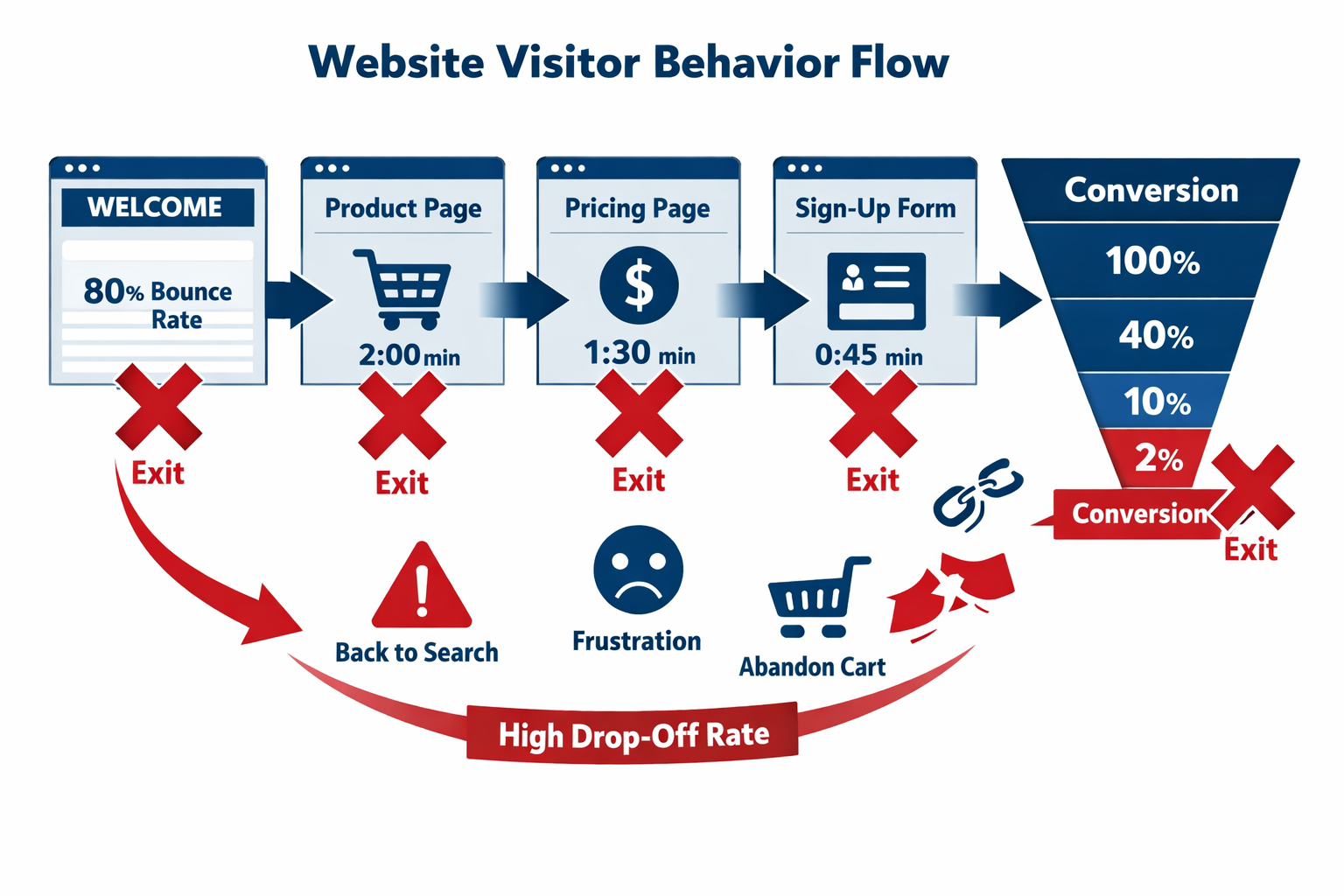
Landscape format (1536x1024) illustration showing website visitor behavior flow diagram with multiple exit points highlighted in red. Visual

Your website is likely costing you sales if visitors aren’t converting into leads, people spend less than 30 seconds on your site, or prospects lose interest after checking you out online. The most common culprits are slow loading times, broken contact forms, poor mobile experience, and unclear messaging. Small businesses typically lose 30-50% of potential sales due to these fixable website problems.

What Does It Mean When Your Website Is Costing You Sales?

Your website is costing you sales when it actively prevents potential customers from taking the next step with your business. This isn’t about having a “bad” website; it’s about having a website that creates barriers instead of removing them.

Think of your website as a digital salesperson. If that salesperson was rude, hard to understand, or disappeared when customers had questions, you’d fire them immediately. Yet many business owners tolerate websites that do exactly that.

Here’s what losing sales online actually looks like:

  • Visitors arrive but leave within seconds
  • People browse your services but never contact you
  • Prospects seem interested in person, but go cold after visiting your site
  • Your phone isn’t ringing despite website traffic
  • Competitors with inferior services are getting the business

The frustrating part? Most website sales problems are completely invisible to business owners. You can’t see the visitors who left because your site loaded too slowly. You don’t know about the potential customers who couldn’t figure out how to contact you. You never hear from the prospects who gave up on your broken contact form.

We’ve seen this pattern repeatedly with small businesses in Metro Atlanta. They’re great at what they do, but their websites are silently sabotaging their growth. The good news? Once you know what to look for, these problems are fixable.

How to Recognize the Warning Signs Your Website Is Hurting Business
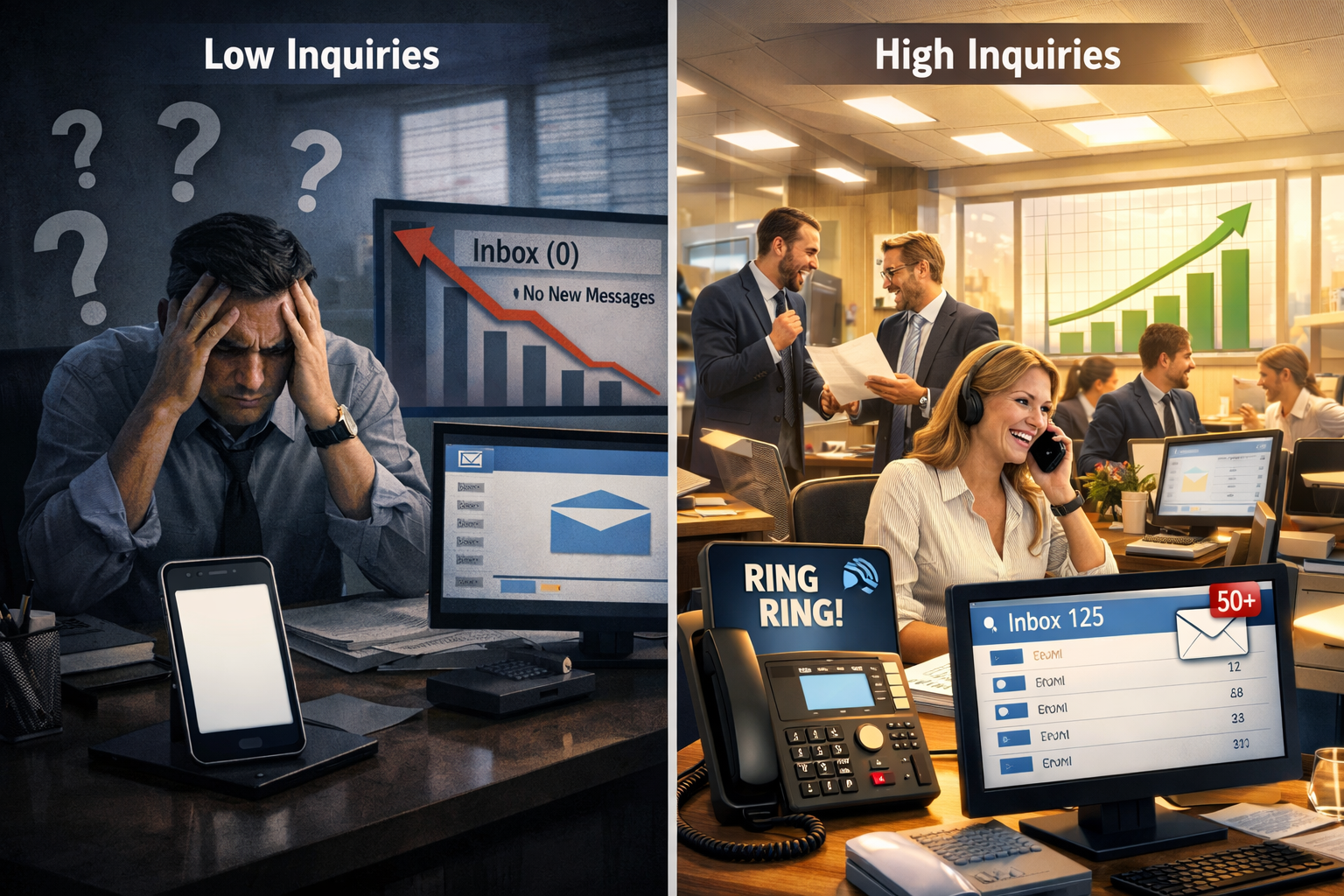
Landscape format (1536x1024) conceptual image showing side-by-side comparison of two business scenarios. Left side: business owner surrounde

The first step to fixing website sales problems is recognizing they exist. Most business owners focus on obvious metrics like total website visitors, but the real warning signs are more subtle.

Low inquiry rates compared to traffic volume are the biggest red flag. If you’re getting decent website traffic, but your phone isn’t ringing, and your email isn’t buzzing with new prospects, something’s broken. A healthy business website should convert 2-5% of visitors into some kind of inquiry or contact. If you’re getting 100 visitors per month and zero inquiries, that’s a problem.

Prospects going silent after visiting your website is another major warning sign. You meet someone at a networking event, they seem interested, you give them your website, and then… nothing. This pattern suggests your website is creating doubt instead of building confidence.

Short visit durations tell a story too. If people are spending less than 30 seconds on your site, they’re not finding what they need. Either your messaging is confusing, your site is hard to navigate, or it’s not loading properly.

Here’s a simple test we recommend: Ask a friend who doesn’t know your business to visit your website and try to contact you. How long does it take them? If it’s more than 10 seconds to find your contact information, you’re losing sales.

Common patterns we see in struggling websites:

  • Contact forms that don’t work (and owners don’t know it)
  • Phone numbers buried in footers or missing entirely
  • Services are described in industry jargon instead of customer benefits
  • No clear next step for interested visitors
  • Mobile sites that are impossible to navigate

The key insight? Your website should make it easier for people to do business with you, not harder. If visitors have to work to figure out what you do or how to contact you, most won’t bother.

The Hidden Costs of Website Sales Problems

When your website is costing you sales, the financial impact compounds over time in ways that aren’t immediately obvious. It’s not just about the customers you’re losing today – it’s about the referrals those customers would have brought, the lifetime value they represented, and the market share you’re handing to competitors.

Let’s break down the real numbers. Say you’re a consulting firm that typically lands clients worth $5,000 each. If your website problems are causing you to lose just two potential clients per month, that’s $120,000 in lost revenue per year. But it gets worse; those clients would have likely referred others, potentially doubling your actual loss.

The opportunity cost is staggering. While you’re wondering why your phone isn’t ringing, your competitors with better websites are capturing those same prospects. Every day your website problems persist, you’re essentially paying for marketing that drives traffic to competitors instead of converting visitors into customers.

Here’s what website sales problems actually cost:

  • Direct lost sales: Immediate revenue from visitors who don’t convert
  • Referral multiplication: Future customers, those lost prospects, would have brought
  • Market positioning: Competitors gain ground while you struggle with lead generation
  • Marketing waste: Every dollar spent driving traffic to a broken website is wasted
  • Time and stress: Constantly wondering why your marketing isn’t working

We worked with a Metro Atlanta accounting firm that was spending $2,000 per month on Google Ads but only getting one or two inquiries. They thought their market was too competitive. The real problem? Their contact form was broken, and mobile visitors couldn’t even see their phone number. Once we fixed these basic issues with our complete done-for-you system, their inquiry rate tripled within 30 days.

The psychological cost matters too. When business owners can’t figure out why their marketing isn’t working, they often blame external factors, such as the economy, competition, or their industry. This leads to poor decisions like cutting marketing budgets or pivoting strategies when the real solution is much simpler.

The most expensive website problem is the one you don’t know exists. That’s why we build websites with AI-powered lead capture and automated follow-up systems that work from day one, ensuring no opportunities slip through the cracks.

Common Website Problems That Kill Sales
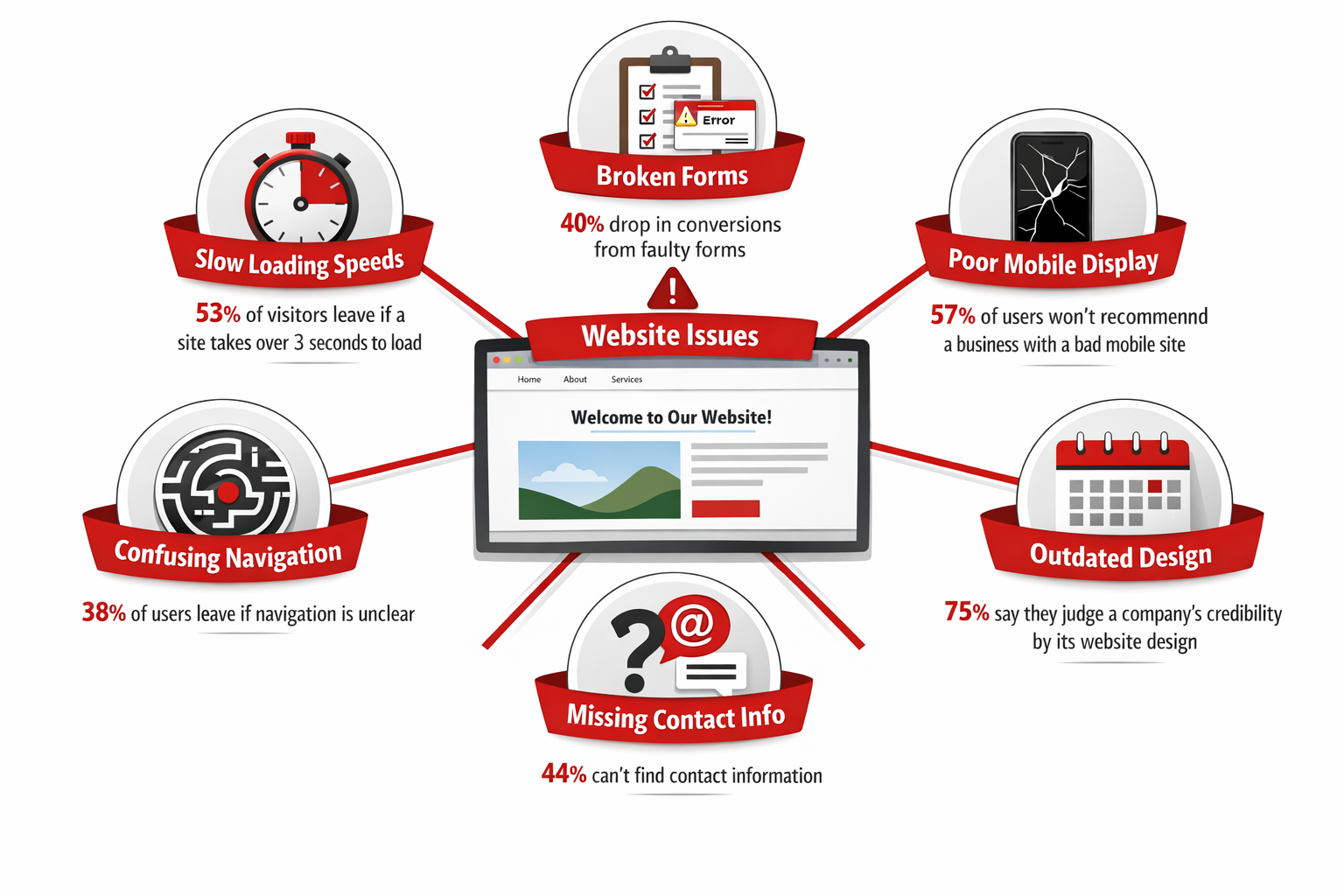
Landscape format (1536x1024) detailed infographic displaying common website problems as warning signs. Central hub design with website mocku

Most website sales problems fall into predictable categories. The frustrating part is that these issues are usually easy to fix once you know what to look for. Here are the most common culprits we see destroying sales for small businesses.

Slow loading speeds are the silent killer of online sales. If your website takes more than 3 seconds to load, you’re losing visitors before they even see what you offer. Mobile users are even less patient; they’ll abandon sites that don’t load within 2 seconds. We’ve seen businesses lose 50% of their potential customers simply because their websites were too slow.

Broken or confusing contact forms are another major problem. You might think your contact form works fine, but many business owners discover their forms have been broken for months without them knowing. Even worse are forms that ask for too much information upfront or don’t clearly explain what happens after someone submits them.

Poor mobile experience is costing businesses massive amounts of money in 2026. More than 60% of website visits now come from mobile devices, but many business websites are still designed primarily for desktop computers. If your site is hard to navigate on a phone, you’re automatically eliminating the majority of your potential customers.

Unclear messaging and value proposition confuse visitors instead of converting them. If someone can’t understand what you do and why they should choose you within 10 seconds of landing on your site, they’ll leave. Many business websites focus on features and credentials instead of clearly explaining the problems they solve and the benefits they provide.

Missing or hard-to-find contact information creates unnecessary barriers. Your phone number and contact form should be visible on every page. If visitors have to hunt for ways to reach you, most won’t bother.

Here’s a quick checklist to identify these problems:

  • Test your site speed at gtmetrix.com (should be under 3 seconds)
  • Submit a test inquiry through your own contact form
  • View your entire website on your smartphone
  • Ask someone unfamiliar with your business to explain what you do after 10 seconds on your homepage
  • Check that your phone number is visible without scrolling on every page

The good news? All of these problems are fixable. Our all-in-one platform addresses each of these issues automatically. We build the website and content with AI-powered lead capture systems that work seamlessly across all devices. Everything’s optimized for speed, mobile experience, and conversion from day one.

The key insight is that your website should remove friction, not create it. Every extra click, confusing element, or technical problem is costing you money. That’s why we focus on building systems that actually work instead of just looking pretty.

How Small Improvements Can Recover Lost Sales Opportunities

The beautiful thing about fixing website sales problems is that small changes often produce dramatic results. You don’t need a complete website overhaul to start recovering lost opportunities; sometimes, a few strategic improvements can double or triple your inquiry rate.

Speed improvements alone can transform your results. We helped a Metro Atlanta HVAC company reduce its website loading time from 8 seconds to 2 seconds. Their inquiry rate increased by 180% within the first month. The fix? Optimizing images and switching to better hosting. Total cost: less than what they were losing in a single day due to slow loading speeds.

Simplifying contact forms creates an immediate impact. Another client was using a contact form with 12 required fields, including detailed project specifications. We replaced it with a simple 3-field form (name, email, phone) and added automated follow-up systems to gather additional details later. Inquiries increased by 220% because the barrier to initial contact was removed.

Mobile optimization unlocks hidden revenue. A professional services firm discovered that 70% of their website visitors were on mobile devices, but their mobile site was nearly unusable. After implementing a mobile-first design with our complete done-for-you system, they saw a 150% increase in mobile inquiries within 60 days.

Clear messaging eliminates confusion. We worked with a business consultant whose website talked about “synergistic solutions” and “optimized methodologies.” Visitors had no idea what he actually did. We rewrote his homepage to clearly explain that he helps small businesses increase profits by streamlining operations. Inquiries went from 2 per month to 15 per month.

Strategic placement of contact information removes barriers. Simply adding a prominent phone number to the header of every page increased one client’s phone inquiries by 90%. The number was always there in the footer, but visitors weren’t scrolling down to find it.

Here’s what these improvements look like in practice:

  • Before: 8-second loading time, 12-field contact form, confusing messaging
  • After: 2-second loading time, 3-field form with automated follow-up, clear value proposition
  • Result: 200%+ increase in qualified inquiries

The key is understanding that every small friction point eliminates a percentage of potential customers. Remove enough friction points, and you can dramatically improve your conversion rate without spending more on marketing.

Our automated follow-up systems take this concept further by ensuring no leads fall through the cracks. Even if someone doesn’t convert immediately, our AI-powered lead capture continues nurturing them until they’re ready to buy. This recovers sales opportunities that would otherwise be lost forever.

The most important insight? Your current website traffic likely contains enough potential customers to grow your business significantly. You don’t need more visitors – you need to convert more of the visitors you already have. That’s exactly what our predictable growth system does: it maximizes the value of every visitor through optimized design, clear messaging, and automated follow-up that works 24/7.

Interactive Website Sales Assessment Tool
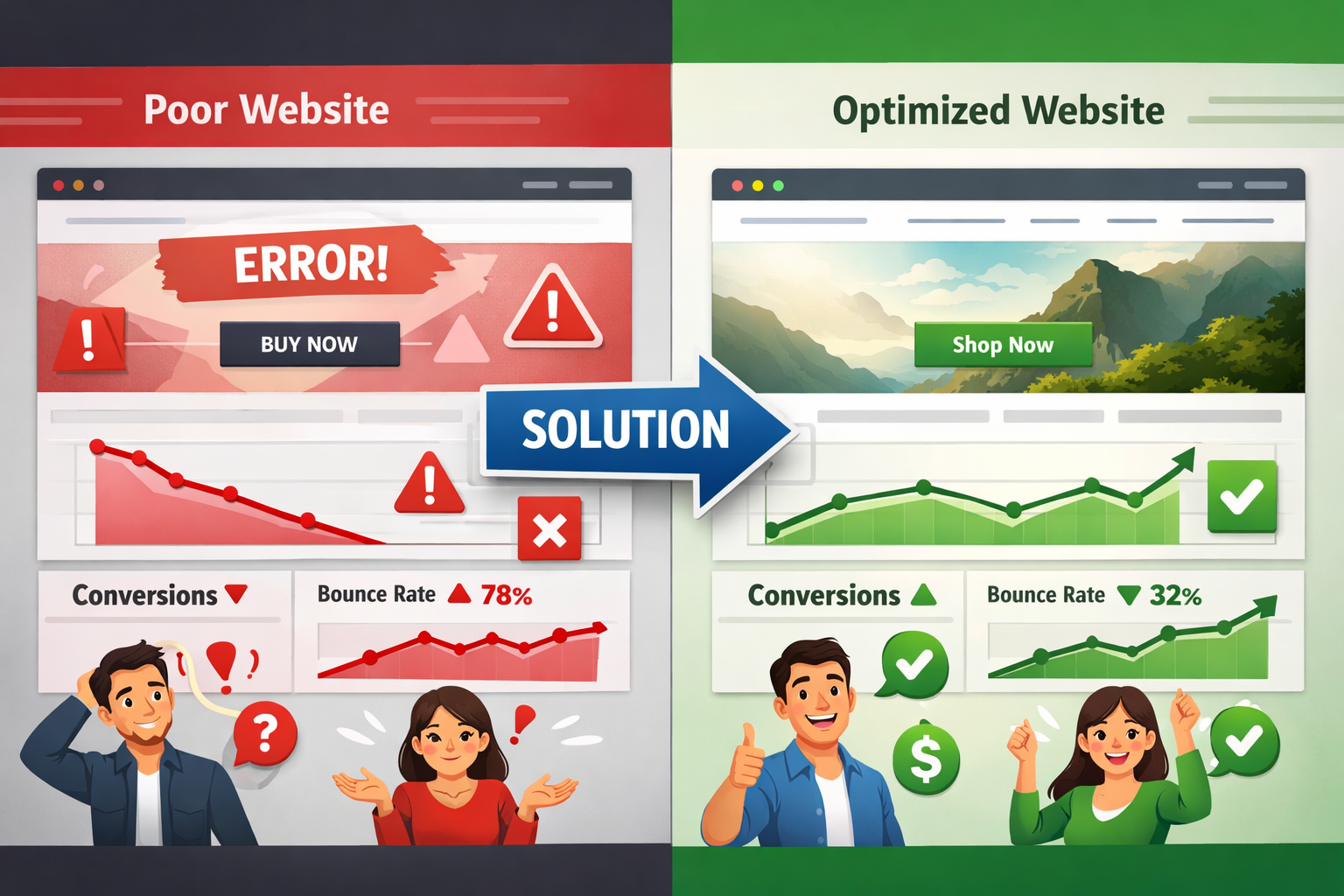
Landscape format (1536x1024) before-and-after transformation visual showing website improvement results. Split composition: left side shows

Website Sales Assessment Tool

Website Sales Assessment Tool

Answer these questions to discover if your website is costing you sales

1. How many inquiries do you typically get per 100 website visitors?

Inquiries per 100 visitors

2. How long does your website take to load?

Website load time

3. How easy is it to contact you from your website on mobile?

Mobile contact ease

4. What happens to prospects after they visit your website?

Prospect behavior after visiting

5. How clear is your value proposition on your homepage?

Homepage value proposition clarity

🚀 Ready to see how this works for your business?

We'll build your complete review generation system in 14 days. No setup fees, no technical headaches. Just a system that works from day one.

📅 Book Your Free Consultation

Why Most Business Owners Don’t Realize Their Website Problems

The biggest challenge with website sales problems is that they’re largely invisible to business owners. Unlike a broken piece of equipment or a rude employee, a problematic website fails silently. You never meet the customers who left because your site was too slow. You don’t get feedback from prospects who couldn’t figure out how to contact you.

The invisibility problem is real. Most business owners judge their websites based on what they can see: the design, the content, maybe the number of visitors. But the critical metrics that actually matter for sales conversion rates, user behavior, and mobile experience are hidden unless you know how to look for them.

We see this pattern constantly in Metro Atlanta. Business owners tell us their website is “fine” because it looks professional and loads properly on their desktop computer. Meanwhile, 70% of their visitors are on mobile devices, struggling with a site that’s nearly impossible to navigate on a small screen. The disconnect between perception and reality is staggering.

The technical knowledge gap makes it worse. Most small business owners don’t have time to become experts in website analytics, conversion optimization, or user experience design. They’re busy running their businesses. So they rely on web designers who focus on making sites look good rather than converting visitors into customers.

Here’s what business owners typically miss:

  • Broken contact forms that appear to work but don’t actually send emails
  • Mobile usability issues that only show up on certain devices or browsers
  • Loading speed problems that vary by location or internet connection
  • Conversion barriers that seem minor but eliminate significant percentages of potential customers
  • Analytics blind spots that hide the true cost of website problems

The “it looks fine to me” trap is particularly dangerous. Your website might load quickly on your high-speed office internet, but crawl for customers on mobile networks. Your contact form might work perfectly when you test it, but fail for visitors using different browsers or devices.

Competitor comparison blindness is another issue. Business owners often assume their websites are adequate because they look similar to competitors’ sites. But if everyone in your industry has poor website conversion rates, being “average” still means losing massive amounts of potential business.

The good news? Once you understand what to look for, these problems become obvious and fixable. That’s why our complete done-for-you system includes built-in monitoring and optimization. We track the metrics that actually matter for sales and make adjustments automatically. No tech knowledge required, everything’s handled for you.

Our AI-powered lead capture systems eliminate the guesswork entirely. Instead of wondering whether your website is working properly, you get clear data on visitor behavior, conversion rates, and lead quality. Plus, our automated follow-up systems ensure that even if someone doesn’t convert immediately, they’re still nurtured until they’re ready to buy.

The key insight is that you can’t fix problems you can’t see. Most business owners are flying blind when it comes to website performance. Our all-in-one platform gives you complete visibility into what’s working and what’s not, then handles the fixes automatically so you can focus on running your business instead of troubleshooting website issues.

Frequently Asked Questions

Q: How can I tell if my website is actually costing me sales?
A: The clearest signs are low inquiry rates relative to your website traffic, prospects going silent after visiting your site, and visitors spending less than 30 seconds on your pages. If you’re getting 100+ monthly visitors but fewer than 2-3 inquiries, your website likely has conversion problems.

Q: What’s a normal conversion rate for a small business website?
A: Healthy small business websites typically convert 2-5% of visitors into some form of contact or inquiry. If you’re below 1%, there are likely fixable problems preventing conversions. Above 5% indicates an exceptionally well-optimized site.

Q: How fast should my website load to avoid losing sales?
A: Your website should load in under 3 seconds on desktop and under 2 seconds on mobile. Every additional second of loading time can reduce conversions by 7-10%. Sites that take longer than 6 seconds to load lose approximately 50% of potential visitors.

Q: Can small website changes really make a big difference in sales?
A: Absolutely. We’ve seen simple changes like fixing broken contact forms, improving mobile navigation, or clarifying messaging increase inquiries by 100-300%. Small friction points eliminate large percentages of potential customers.

Q: How do I know if my contact form is actually working?
A: Test it yourself from different devices and browsers, then have friends or colleagues test it too. Many business owners discover their forms have been broken for months. Also, check your spam folders for submissions that sometimes get filtered incorrectly.

Q: What’s the biggest website mistake small businesses make?
A: Focusing on how the website looks rather than how it converts. A beautiful website that doesn’t generate inquiries is worthless for business growth. The biggest mistake is not tracking conversion metrics and user behavior.

Q: How important is mobile optimization for small businesses?
A: Critical. More than 60% of website visits now come from mobile devices. If your site isn’t optimized for mobile, you’re automatically eliminating the majority of your potential customers. Mobile optimization isn’t optional anymore.

Q: Should I rebuild my website or try to fix existing problems?
A: It depends on the severity of the issues. Simple problems like slow loading or broken forms can often be fixed. But if you have fundamental mobile usability issues, unclear messaging, or poor conversion flow, a rebuild might be more cost-effective.

Q: How long does it take to see results from website improvements?
A: Basic fixes like speed optimization and form repairs can show results within days. More comprehensive improvements typically show measurable results within 30-60 days. The key is making changes based on actual user behavior data rather than guesswork.

Q: What’s the difference between website traffic and website conversions?
A: Traffic is the number of people visiting your site. Conversions are visitors who take desired actions like contacting you or requesting information. High traffic with low conversions usually indicates website problems that are preventing sales.

Q: How can I track whether my website improvements are working?
A: Monitor key metrics like inquiry rates, time spent on site, mobile vs desktop conversion rates, and form completion rates. Set up simple tracking to measure before and after performance. The goal is more qualified inquiries, not just more traffic.

Q: What should I do if I don’t have time to fix these website problems myself?
A: Consider a complete done-for-you system that handles website optimization, lead capture, and automated follow-up automatically. This eliminates the need for technical knowledge while ensuring your website actually generates sales instead of costing them.

Key Takeaways: Stop Letting Your Website Cost You Sales

• Website problems are invisible but expensive – You never see the customers who leave due to slow loading, broken forms, or poor mobile experience, but they’re costing you thousands in lost revenue

• Small fixes create big results – Simple improvements like optimizing loading speed, fixing contact forms, and improving mobile navigation can double or triple your inquiry rate within 30-60 days

• Conversion rate matters more than traffic – A healthy small business website should convert 2-5% of visitors into inquiries; if you’re below 1%, fixable problems are preventing sales

• Mobile optimization isn’t optional – With 60%+ of visits coming from mobile devices, a poor mobile experience automatically eliminates most potential customers

• Speed kills sales – Websites that take longer than 3 seconds to load lose significant percentages of visitors before they even see your content

• Clear messaging drives action – Visitors should understand what you do and why they should choose you within 10 seconds, or they’ll leave for competitors

• Contact barriers eliminate customers – If it takes more than 10 seconds to find your contact information or submit an inquiry, you’re losing sales to businesses that make it easier

• Testing reveals hidden problems – Many website issues only show up when tested from different devices, browsers, or network conditions

• Automated systems capture missed opportunities – AI-powered lead capture and automated follow-up can recover sales from visitors who don’t convert immediately

• Professional systems work better – Done-for-you platforms that handle optimization, lead capture, and follow-up automatically typically outperform DIY website solutions for small businesses

Conclusion: Turn Your Website Into a Sales Asset

Your website should be your best salesperson, working 24/7 to capture leads and nurture prospects. If it’s not doing that job effectively, every day you wait to fix the problems is money walking out the door.

The good news is that most website sales problems are completely fixable. You don’t need a massive budget or technical expertise; you just need to focus on the elements that actually drive conversions rather than just looking pretty.

Here’s your action plan:

Start with a quick assessment using the tool above to identify your biggest problem areas. Focus on the issues that are likely costing you the most money – usually loading speed, mobile experience, and contact process.

Test everything from your customers’ perspective. Visit your website on your phone, try to contact yourself, and time how long each step takes. If you’re frustrated by the experience, your potential customers definitely are.

Consider a complete done-for-you system if you don’t have time to handle optimization yourself. Our all-in-one platform builds websites with AI-powered lead capture and automated follow-up systems that work from day one. No tech knowledge required, everything’s ready to generate sales immediately.

The cost of doing nothing is too high in 2026. While you’re wondering why your phone isn’t ringing, competitors with better websites are capturing your potential customers. But once you fix these problems, you’ll be amazed at how much business was already there waiting – you just needed to make it easier for people to find and contact you.

Your website should remove barriers between prospects and your business, not create them. Make that shift, and watch your sales grow.

Ready to stop losing sales to website problems? We build complete systems that capture and nurture leads automatically – everything is ready from day one with no tech knowledge required.

🚀 Ready to see how this works for your business?

We'll build your complete review generation system in 14 days. No setup fees, no technical headaches. Just a system that works from day one.

📅 Book Your Free Consultation
author avatar
Danillo

Leave a Reply

Your email address will not be published. Required fields are marked *